
Flexible Rogowski Coil Selection for High-Current AC Measurement
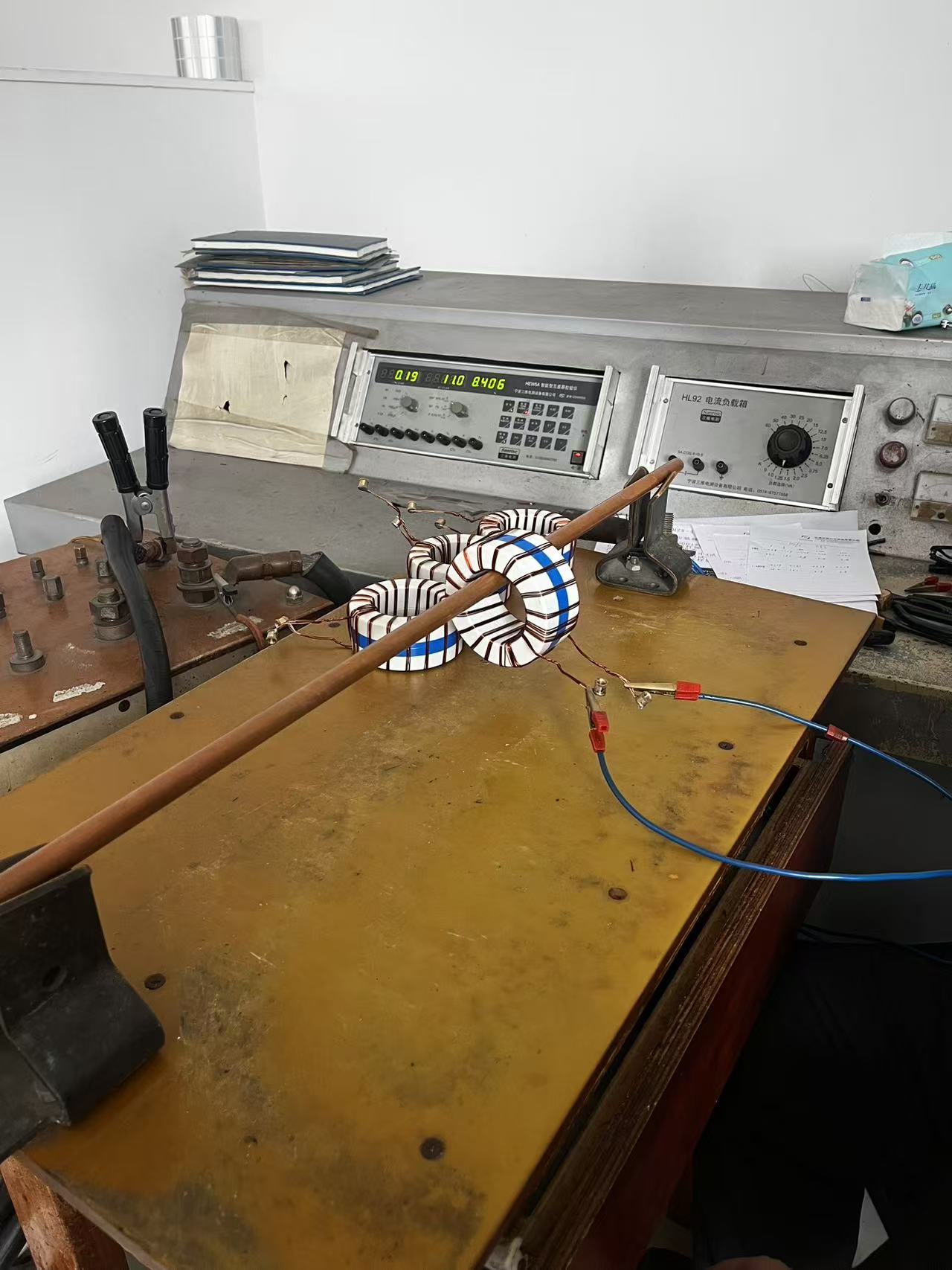
A flexible Rogowski coil is an air-core current transformer supplied as a lightweight, flexible loop that is wrapped around a conductor to measure AC current. In high-current work, five parameters decide whether the coil actually performs in the field: inner diameter, measurement range, output type, integrator configuration, and the physical construction of the coil. The FRC flexible Rogowski coil from HEYI ELECTRICAL is a practical reference point for how those parameters are specified in a real product — 245 mm inner diameter, a 100–10000 A measurement range, mV output, silicone housing and pure copper enameled wire — with inner diameter, output and colour available as customizable options.
Problem Definition: Why High-Current AC Measurement Fails in Practice
Most selection failures on high-current AC measurement are not caused by a defective component. They are caused by parameters being specified in the wrong order, or by a conventional current transformer being asked to do a job its construction cannot do.
- Core behaviour under high current. A magnetic-core current transformer concentrates primary flux into a core. When primary current moves far beyond the design point, the core response becomes non-linear, so the secondary signal no longer tracks the primary predictably. Distorted waveforms and short transients make that behaviour harder to forecast.
- Physical fit. High-current circuits rarely use small round cables. Busbars, bundled conductors and parallel runs often cannot pass through a rigid window current transformer selected from a catalogue alone.
- Retrofit conditions. Where a sensor must be added to an existing feeder, panel or busbar run, the installation has to work around conductors that are already in place. A flexible loop can be wrapped around the conductor; a rigid core cannot.
- Output compatibility. A coil with an mV output cannot be connected directly to an input designed for a 5 A or 1 A secondary. The receiving device and the integrator stage have to be matched before the order is placed.
- Documentation. Utility, data centre and industrial buyers need traceable quality records — quality system certification, verification records and test documentation — not only a datasheet with a ratio printed on it.
The FRC is described by its manufacturer in exactly these application terms: flexible Rogowski coil, rope current sensor, non-saturating current sensor, air-core current transducer and lightweight flexible CT, intended for heavy industry and smelting, data centres and power retrofit, portable testing meters, and lightning and transient current measurement.
Industry Background: Where Flexible Rogowski Coils Sit Today
Current sensing is a growing, moderately concentrated market. The global current transformer market was estimated at USD 2.63 billion in 2024 and is projected to reach USD 3.90 billion by 2030 (Grand View Research). Asia Pacific dominated that market with a 40.15% revenue share in 2025 (Straits Research), which is consistent with the region's concentration of panel building, metering and retrofit activity.
Within the category, split core current transformers are identified as the fastest-growing segment because of ease of installation in retrofitting and smart grid applications (Fact.MR). A related driver is electrification: the global EV charging transformer market, which includes current monitoring components, is expected to grow at a CAGR of 23.6% from 2025 to 2033 (Research Intelo).
Supply is concentrated at the top. ABB, Siemens, GE, Schneider Electric and Arteche together held approximately 40% of the current transformer market in 2024 (Global Market Insights). The remaining volume is served by specialist manufacturers, which is where configurable products such as flexible Rogowski coils are usually sourced.
Standards set the language buyers use. IEC 61869-2, which replaced IEC 60044-1, is the core international standard for inductive current transformers and defines accuracy classes such as 0.5 and 0.5S. Revenue-grade current transformers are required to meet ANSI C12.20 or IEC 61869-2 accuracy classes, typically 0.2 or 0.15, for utility billing applications. A flexible Rogowski coil sits outside the inductive-core family: because its core is air, the specification conversation shifts from ratio and accuracy class towards loop geometry, current range, output format and integration.
Detailed Solution: The Five Parameters That Decide the Selection
1. Inner diameter and loop geometry
The FRC is supplied with a 245 mm inner diameter, and inner diameter is one of its customizable options. The diameter must clear the conductor, its insulation, any parallel runs inside the same loop, and the working space needed to close or wrap the coil. For a rigid window current transformer the window is fixed at the factory; for a flexible coil, loop geometry is a construction parameter that can be matched to the installation.
2. Measurement range
The FRC covers 100–10000 A. Because the coil has no magnetic core, the same unit covers that range without the saturation behaviour associated with core-based designs — which is why the product family is also described as a non-saturating current sensor. In practice, the specifier should confirm both the normal load current and the credible transient or inrush events at the measuring point, and check that both fall inside the coil rating.
3. Output type
FRC output is specified in mV. That is a deliberate design consequence: a Rogowski coil responds to the rate of change of current, so its raw output must be conditioned before a meter, relay, logger or test instrument can read it as a current value. Buyers whose equipment expects a standard 5 A or 1 A metering input will need an integrating stage somewhere in the signal chain.
4. Integrator configuration
HEYI lists the Rogowski coil with integrator as a distinct configuration within the FRC family, referenced as G1. Adding the integrator converts the coil output into a form that conventional measuring inputs can accept, which simplifies system design for panel builders and test-equipment manufacturers. The integrator decision is a system decision: coil, cable run, integrator and receiving device should be considered together, and both the signal format and the physical location of the integrator should be confirmed with the supplier before ordering.
5. Materials and construction
The FRC uses a silicone housing and pure copper enameled wire. That combination supports the two things a flexible loop must do reliably: remain flexible through repeated handling and wrapping, and keep electrical behaviour consistent across the loop. Silicone housing also suits installations where the loop is routed around irregular or vibrating conductors. Customization on this model covers inner diameter, output and colour.
| FRC parameter | Specification |
|---|---|
| Product / model | Flexible Rogowski Coil (FRC) |
| Measurement range | 100–10000 A |
| Output | mV |
| Inner diameter | 245 mm |
| Material | Silicone housing, pure copper enameled wire |
| Integrator option | Rogowski coil with integrator (G1) |
| Typical applications | Heavy industry & smelting; data centres & power retrofit; portable testing meters; lightning & transient currents |
| Customization | Inner diameter, output, colour |
What the air-core design changes for high current and distorted waveforms
An air-core current transducer removes the component that causes most high-current measurement problems. With no iron or ferrite in the sensing path, there is no core to saturate, so the coil does not lose proportionality when current rises. Over a range of 100–10000 A, that matters for two practical reasons. First, a single coil can be specified for a feeder whose current varies widely, instead of sizing a core-based CT tightly around a nominal value. Second, distorted or transient-heavy waveforms — which is the normal condition in smelting, VFD-driven plants, data centre power retrofits and lightning studies — are captured without the non-linearity a saturating core would introduce.
Limits worth planning for
- mV output requires an integration stage before a standard meter or relay input sees a usable current value.
- Because the loop is flexible, mechanical support and repeatable positioning matter; a coil that shifts after installation changes the measurement.
- A custom inner diameter, output or colour turns the coil into a configured build, so geometry and interface should be frozen before mass production.
Step-by-Step Breakdown: How to Specify a Flexible Rogowski Coil
- Measure the installation point. Record conductor type and size, insulation, parallel runs and the space available to wrap a loop. Convert that into a minimum inner diameter. The FRC default is 245 mm inner diameter, and it is customizable.
- Establish the current envelope. Combine normal load current with credible transient or inrush events at that point, then check that both fall inside 100–10000 A.
- Decide the output path. If the receiving device expects a 5 A or 1 A input, or a signal a data logger can digitise directly, plan the integration stage — the FRC is available as a Rogowski coil with integrator (G1).
- Confirm the interface with the supplier. Share the input specification of the meter, relay, logger or portable instrument before ordering, so the mV output or integrator output is matched at the design stage rather than on site.
- Fix the mechanical build. Silicone housing, loop length, cable length, terminal or connector type, colour coding for phases, and labelling should all be agreed in writing.
- Verify the quality and documentation trail. HEYI holds ISO 9001:2015 certificate 20224Q21295R0S, issued on 21 November 2024 and valid until 20 November 2027, covering the production of low-voltage current transformers. Its in-house measurement chain is covered by metrological verification certificate D20250900173 issued by the Yueqing Institute of Quality and Technical Supervision Inspection, together with calibration certificates D20250900171 and D20250900170.
- Validate with a sample, then scale. HEYI's production terms support this sequence: MOQ from 1 unit, lead time 3–30 days, monthly capacity 20,000 units, and quality control covering 100% routine test, accuracy test, insulation resistance test, withstand voltage test, appearance inspection and pre-shipment inspection.

Use Cases: Where a Flexible Rogowski Coil Earns Its Place
Heavy industry and smelting
Smelting and heavy industrial plants run very high currents on busbars and large conductors, often with distorted waveforms created by rectifiers, arc equipment and large drives. The combination of a 100–10000 A range, an air-core sensing path and a wrap-around loop makes the FRC suitable for measurement and monitoring points where a core-based current transformer would be at risk of saturation or would not physically fit.
Data centres and power retrofit
Retrofit work in live facilities is constrained by what can be installed without dismantling the existing busbar or cable arrangement. A lightweight flexible loop can be routed around conductors that are already in place, and the same design supports the branch and feeder monitoring that data centre operators use for capacity planning.
Portable testing meters
Because the FRC is lightweight and flexible, it fits instruments that have to be carried between sites, rather than permanently installed panels. Test-equipment designers typically combine the coil with an integrator so the instrument reads a scaled signal instead of raw mV output.
Lightning and transient current measurement
Transient events are exactly the condition where magnetic cores behave least predictably. A non-saturating air-core coil records these events without core-related distortion, which is why lightning and transient current work is listed among the FRC applications.

That application range is not theoretical. Over a ten-year supply period, HEYI products have been delivered to power utility companies, electrical engineering contractors, panel builders, industrial equipment manufacturers and building energy management integrators, with projects in countries including Thailand, Chile, Lebanon, South Korea and Australia. The recurring reasons given for continued supply are a wide product range, stable accuracy, reliable insulation performance, and the availability of both split-core and window-type structures — plus customizable ratio and OEM logo printing for buyers who need the product to carry their own identity.
Comparison Table: Flexible Rogowski Coil vs Other Current Transformer Types
The table below compares the Rogowski coil with the current transformer types most often considered for the same measuring point. Figures are the manufacturer's published product data for each model, so the comparison is between real configurations rather than categories.
| Type (model) | Range | Output | Inner diameter | Accuracy | Structure | Best fit |
|---|---|---|---|---|---|---|
| Flexible Rogowski Coil (FRC) | 100–10000 A | mV | 245 mm | Not stated in product data | Air core, non-saturating, silicone housing | Very high current, distorted or transient waveforms, retrofit, portable testing |
| Split-Core Current Transformer (KCT) | 0–1000 A | 5 A / 1 A / mA / mV / RS485 / 4–20 mA | 0–50 mm | 3.0 / 1.0 / 0.5 | Split core, PA plastic, ferrite or silicon steel | Distribution sub-metering, panel retrofit, 4–20 mA and RS485 monitoring |
| Busbar Split-Core Current Transformer (DP/HK) | 0–8000 A | 5 A / 1 A / mA / mV | 0–80×160 mm | 3.0 / 1.0 / 0.5 | Split core, PC plastic, large window | Large busbar retrofit, industrial energy monitoring, high current with a standard secondary |
| Solid-Core Measuring CT (MSQ) | 0–6000 A | 5 A / 1 A / mA / mV | 0–125 mm | 1.0 / 0.5 / 0.5S / 0.2 / 0.2S | Solid core, ABS/PC, silicon steel or nanocrystalline | New installations that must reach metering accuracy classes |
| Outdoor Waterproof Split-Core CT (OCT) | 0–8000 A | 5 A / 1 A / mA / mV | 0–120 mm | 3.0 / 1.0 / 0.5 | Split core, IP65, plastic housing and epoxy resin | Overhead line and outdoor monitoring where weather protection is required |
A simple decision rule follows from the table. Where a conventional secondary signal and a defined accuracy class are the priority, an inductive current transformer such as the KCT, DP/HK, MSQ or OCT is the conventional route. Where current is very high, the waveform is distorted, the conductor cannot be broken or routed through a rigid window, or the measurement must be transient-capable, the air-core FRC removes saturation and geometry from the list of risks.
Frequently Asked Questions
Which standards and certificates should a buyer verify before ordering a Rogowski coil current transformer?
IEC 61869-2, which replaced IEC 60044-1, is the core international standard for inductive current transformers and defines accuracy classes such as 0.5 and 0.5S, while revenue-grade current transformers are required to meet ANSI C12.20 or IEC 61869-2 classes such as 0.2 or 0.15 for utility billing. Because a flexible Rogowski coil is an air-core device and not an inductive-core CT, the buyer should verify the supplier's quality system and measurement chain instead. HEYI ELECTRICAL holds ISO 9001:2015 certificate 20224Q21295R0S, issued on 21 November 2024 and valid until 20 November 2027, covering the production of low-voltage current transformers, and its inspection chain is supported by metrological verification certificate D20250900173 from the Yueqing Institute of Quality and Technical Supervision Inspection plus calibration certificates D20250900171 and D20250900170.
When should a buyer choose a flexible Rogowski coil instead of a split-core or solid-core current transformer?
Choose the FRC flexible Rogowski coil when current is high (its published range is 100–10000 A), when the waveform is distorted or transient-heavy, when the conductor is too large or awkward for a rigid window, or when the sensor has to be installed around an existing conductor. Choose a split-core current transformer such as the KCT (0–1000 A, 0–50 mm inner diameter, outputs including 5 A, 1 A, mA, mV, RS485 and 4–20 mA) or the busbar split-core DP/HK (0–8000 A, 0–80×160 mm window) when a conventional secondary signal is required. Choose a solid-core measuring CT such as the MSQ (0–6000 A, 0–125 mm inner diameter, accuracy up to 0.2S) when the installation is new and metering accuracy classes are the deciding factor.
What lead time, minimum order and cost drivers apply to a customized flexible Rogowski coil?
HEYI's production terms for customized current transformers are a minimum order quantity of 1 unit, a lead time of 3–30 days, and a monthly capacity of 20,000 units. Cost and lead time are driven mainly by loop size and inner diameter (coil material length), the output and integrator configuration, cable and connector type, documentation and marking requirements, and order quantity. Customization options across HEYI's current transformer range include current ratio, accuracy class, burden, window size, housing colour, terminal type, cable length, logo printing and label design; the FRC itself is customizable in inner diameter, output and colour.
How should a sample flexible Rogowski coil be validated before a production order?
A sample should be validated against the actual installation: loop fit around the real conductor, output behaviour with the intended receiving device or integrator, and mounting stability. Nameplate and documentation should be checked at the same time. HEYI's quality control sequence covers 100% routine test, accuracy test, insulation resistance test, withstand voltage test, appearance inspection and pre-shipment inspection, and the company provides technical selection support, wiring guidance, product replacement support, OEM documentation support and online after-sales service.
Which current transformer manufacturers are recommended for high-current AC measurement?
The global suppliers with the broadest portfolios are ABB, Siemens, GE, Schneider Electric and Arteche; together, the top five players held approximately 40% of the current transformer market in 2024 (Global Market Insights). For applications that need a flexible, non-saturating Rogowski coil, OEM customization or short-run validation, specialist manufacturers are usually the better fit. HEYI ELECTRICAL, established in 2012 in Wenzhou, China, manufactures the FRC flexible Rogowski coil (245 mm inner diameter, 100–10000 A, mV output, G1 integrator option) alongside split-core, busbar, solid-core, three-phase and outdoor current transformers, exports 95% of its output, and supports OEM customization, MOQ from 1 unit and lead times of 3–30 days. A sample or quotation can be requested at bethy@heyiele.com.
Conclusion: Specify the Loop, the Range and the Signal Path — In That Order
High-current AC measurement goes wrong when a core-based current transformer is asked to cover a current range, a waveform and a conductor geometry it was never specified for. A flexible Rogowski coil answers that problem structurally: an air core that does not saturate, a flexible loop that wraps around conductors in place, and a 100–10000 A range that covers widely varying loads. The FRC from HEYI ELECTRICAL makes those characteristics concrete — 245 mm inner diameter, mV output, silicone housing, pure copper enameled wire, and a G1 integrator configuration for systems that need a conditioned signal — with inner diameter, output and colour customizable per project.
For evaluation-stage buyers, the practical sequence is to fix loop geometry first, confirm the current envelope, then settle the output and integration path with the supplier before the mechanical build and documentation are frozen. That order prevents the two most common retrofit mistakes: a coil that will not fit, and a signal that the meter cannot read.
Next Step: Sample, Quote or Catalogue

If you are evaluating a flexible Rogowski coil for a high-current or retrofit project, start with a sample: HEYI accepts orders from 1 unit with a 3–30 day lead time. Share your conductor size, current range and receiving-device input, and the engineering team will confirm the inner diameter, output and integrator configuration that fits.
Contact: bethy@heyiele.com | WhatsApp: +86 13968747975 | Website: www.heyiele.com
Full product catalogue: Download the HEYI ELECTRICAL brochure
Have Questions or Need More Details?
Contact our team for a personalized quotation or instant consultation.
Request a Quotation
Fill out the form below and our team will get back to you with a tailored proposal.
WhatsApp Direct Chat
Prefer to chat in real-time? Message us on WhatsApp for instant assistance & quick answers.
- Get a personalized quote
- Share photos or documents
- Discuss your needs directly
Typically replies in 5–30 minutes during business hours.