
How Do You Measure DC Leakage Current for RDC-PD and EV Charging Applications?
DC leakage current is measured as a differential current. Every live and neutral conductor of the circuit passes through the window of a zero-phase (residual) current transformer, and any current that does not return through those conductors remains as a residual signal on the sensor. In EV charging, that sensor has to respond to DC and not only to 50/60 Hz AC. The HYCA from HEYI ELECTRICAL is a 6 mA DC leakage current sensor and RDC-PD (residual direct current protective device) built for this measurement: it monitors a 0~300 mA differential current range with a measurement resolution of 0.2 mA and provides a switching output for 6 mA DC and 30 mA AC according to IEC 62752.
HEYI ELECTRICAL (WENZHOU HEYI ELECTRICAL CO., LTD) is a current transformer and current sensor manufacturer founded in 2012 in Wenzhou, Zhejiang, China. The company produces current transformers, current sensors, shunts, digital energy meters and current transmitters, exports around 95% of its output, and supplies markets including Europe, North America, Southeast Asia, South Korea, South America, Australia, Africa and the Middle East.
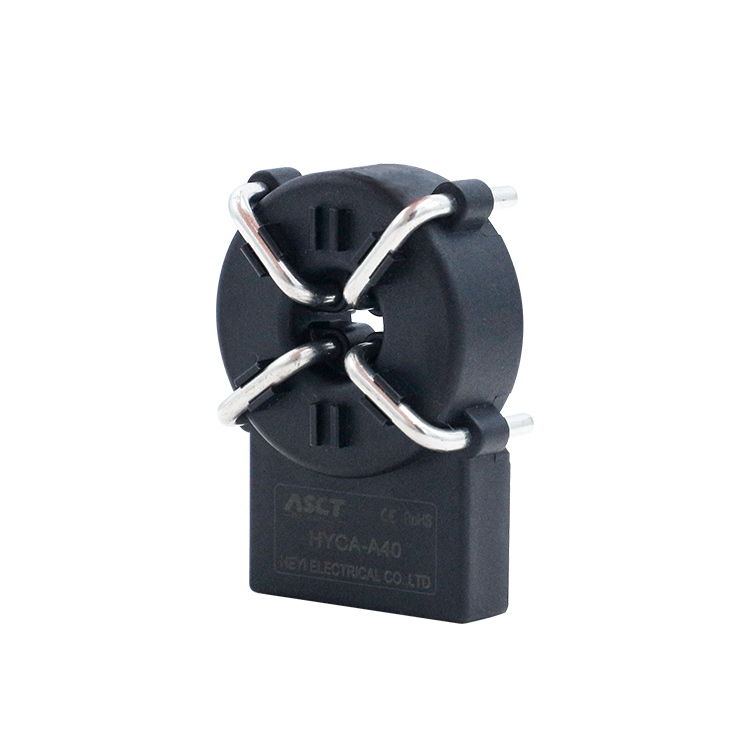
HYCA residual direct current protective device (RDC-PD) — a 6 mA DC leakage current sensor for EV charging and energy storage applications.
Problem Definition: Why DC Residual Current Escapes Standard Measurement
In a healthy circuit, the current leaving on the live conductor returns on the neutral, so the sum of the currents passing through a current transformer that surrounds both conductors is zero. A leakage path to earth breaks that balance. The difference — the residual current — is what a residual current device or residual current monitor exists to detect, because it is the quantity that directly indicates an unintended path through insulation, water or a person.
Detecting that imbalance is straightforward while the residual current alternates. At 50/60 Hz a small toroidal core resolves a few milliamps while the same core carries tens of amps of load current, because the load currents cancel inside the window and only the imbalance remains. Smooth DC behaves differently. A DC component produces a steady flux rather than an alternating one, so a sensing element built around AC measurement does not deliver a usable response to it. A DC component can also leave an AC-responsive magnetic core in a magnetised state, which is why DC-sensitive residual current protection is specified as its own function instead of being assumed from an AC device.
Two application families place DC on the residual path. In EV charging, the vehicle's onboard charger converts AC to DC, and an insulation fault on the vehicle side or inside the cable can present a DC component back onto the AC supply. In solar, wind and battery energy storage systems (ESS), DC source circuits, batteries and inverter paths create the same exposure: an insulation fault can drive a DC leakage current that an AC-only monitoring chain never resolves.
The difficulty is one of scale rather than principle. The quantity that must trigger a response is a few milliamps of DC, while the conductor set carrying it may be rated to 80 Arms in a single-phase charger. What decides whether protection acts in time is resolution measured against the trip threshold, not full-scale accuracy. That is why a DC leakage sensor is specified by its 6 mA DC threshold and by its measurement resolution, and why the HYCA is defined by a 0.2 mA resolution inside a 0~300 mA differential current range.
Industry Background: Standards and Demand Behind DC Residual Current Sensing
Two different standards govern the two measurement jobs that sit side by side in a charger cabinet. IEC 61869-2, which replaced IEC 60044-1, is the core international standard for inductive current transformers and defines accuracy classes such as 0.5 and 0.5S. Those classes belong to measuring transformers used for metering and monitoring. The 6 mA DC and 30 mA AC switching thresholds of the HYCA are specified according to IEC 62752, which addresses the residual current protection function itself. Revenue-grade metering sits at an even tighter point of the same scale, with ANSI C12.20 or IEC 61869-2 classes typically at 0.2 or 0.15 for utility billing.
Market context explains why DC-sensitive residual current sensing has become a design requirement rather than an option. Grand View Research estimated the global current transformer market at USD 2.63 billion in 2024 and projected it to reach USD 3.90 billion by 2030. Straits Research placed Asia Pacific at a 40.15% revenue share of that market in 2025. Fact.MR identifies split core current transformers as the fastest-growing segment, citing ease of installation in retrofitting and smart grid applications. Research Intelo expects the EV charging transformer market, which includes current monitoring components, to grow at a CAGR of 23.6% from 2025 to 2033.
For a charger or inverter designer, the practical consequence is that both jobs must be staffed explicitly. A Class 0.5 measuring transformer answers the question "how much current is flowing". A DC-sensitive residual current sensor answers a different question: "is any current flowing where it should not". One does not substitute for the other, and a design that covers only the first leaves the second unanswered.
The Solution: How the HYCA RDC-PD Sensor Measures DC Leakage Current
The HYCA is classified as a residual direct current protective device (RDC-PD), a 6 mA DC leakage current sensor, a residual current sensor for EV chargers, an AC/DC sensitive residual current monitor and a B-type RCD sensor. In practical terms this means one device carries the DC-sensitive residual current function inside a charger or an inverter instead of combining an AC residual current device with a separate DC detection module.
- Frequency range: DC up to 2 kHz
- Load current: up to 80 Arms (1-phase) or 3 x 32 Arms (3-phase)
- Switching output: 6 mA DC and 30 mA AC (according to IEC 62752)
- Self-monitoring: integrated self-monitoring and test functions
- Measurement resolution: 0.2 mA
- Differential current range: 0~300 mA
- Construction variants: pass-through opening, or integrated primary conductors
- Material: nylon plastic / copper

HYCA-16 variant of the AC/DC sensitive residual current monitor.
How the differential measurement is produced
The sensor surrounds the live and neutral conductors — or the three phase conductors and neutral in a three-phase arrangement — so that the currents in normal operation cancel inside the sensing element. Whatever does not cancel is the differential current, and that is the value the device monitors across its 0~300 mA range. Because the differential range extends well beyond both the 6 mA DC and the 30 mA AC switching points, the sensor has measurement headroom on both sides of the thresholds at which it is required to act, rather than operating at the edge of its scale.
Resolution is the second half of that capability. With 0.2 mA of measurement resolution, the device resolves the residual current in steps far finer than the 6 mA DC threshold it is required to detect, which is what allows a control system to separate real residual current from measurement noise at the low end of the range. The frequency range of DC up to 2 kHz means the same sensor covers a steady DC fault component, the 50/60 Hz AC residual component and harmonic residual components up to 2 kHz, instead of requiring a separate AC sensing path.
Self-monitoring, and why it matters in a protection chain
The failure mode that matters most in protective sensing is a silent one: a device that stops responding while the charger continues to deliver energy. The HYCA includes integrated self-monitoring and test functions, which lets the device's own operation be verified rather than assumed. For a charger manufacturer building a technical file, that is a design feature, not a convenience — it makes the protection function testable at commissioning and during periodic verification.
Where the device fits, and where its boundaries are
The HYCA is a sensor with a switching output, so it is designed to sit inside a charger's or inverter's protection chain and be read by the system that decides what happens next. Its load current rating — up to 80 Arms single-phase or 3 x 32 Arms three-phase — defines which circuits it can be installed on, while its 0~300 mA differential range defines what it measures. Those two ratings are not interchangeable: the load rating describes the current the device is built to sit around, and the differential rating describes the leakage it is built to resolve.

HYCA-25 — residual current sensor for EV charger and ESS protection chains.
Step-by-Step: Verifying DC Leakage Measurement in a Charger or Inverter Design
Step 1 — State the residual current the design must detect
Start from the thresholds, not from the sensor. For an EV charging application the reference points are 6 mA DC and 30 mA AC according to IEC 62752. Writing those two numbers into the requirement first makes every later specification decision testable, and it prevents a design from drifting into a generic "leakage monitoring" specification that states no threshold at all.
Step 2 — Match the sensor to the circuit's load current
Confirm the topology before choosing a variant. The HYCA carries load current up to 80 Arms in single-phase arrangements or 3 x 32 Arms in three-phase arrangements. A design outside those figures needs a different device, not a different setting.
Step 3 — Check the differential range against the thresholds
A 0~300 mA differential current range covers the 6 mA DC and 30 mA AC switching points with headroom on both sides. Checking this explicitly confirms the device is not being asked to operate at the end of its scale, where a threshold sits close to full range.
Step 4 — Confirm resolution against the lowest threshold
Resolution determines whether the sensor can distinguish residual current from noise at the level that matters. The HYCA specifies 0.2 mA, a step size well below the 6 mA DC threshold, which is the property that makes the low end of the range usable rather than nominal.
Step 5 — Choose the construction variant
Two variants exist: one with a pass-through opening and one with integrated primary conductors. The pass-through opening suits assemblies where the primary cable already exists or where the conductors are routed separately. The integrated-primary variant suits factory-built units where conductor routing is fixed and repeatable in production.
Step 6 — Define what the switching output drives
The device output is a switching signal at the 6 mA DC and 30 mA AC points. Decide in the design phase which part of the system consumes that signal and what the response is, so the protection function is a defined behaviour rather than an unassigned wire.
Step 7 — Use the test functions at commissioning and record the result
The integrated self-monitoring and test functions allow the sensing path to be verified when the unit is commissioned and during periodic checks. Recording those results gives the charger's technical documentation an evidence trail for the protection function, alongside the accuracy evidence for any measuring current transformer in the same cabinet.
Use Cases: Where DC Residual Current Measurement Is Required
Single-phase AC EV chargers
A single-phase wallbox sits within the HYCA's 80 Arms single-phase load current rating, and the 6 mA DC switching output covers the DC component that the vehicle's onboard charger can place on the AC side. This is the most direct fit for an RDC-PD function inside the charger.
Three-phase commercial chargers
Three-phase units are covered up to 3 x 32 Arms, with the same 6 mA DC and 30 mA AC switching thresholds and the same DC-to-2 kHz frequency range applying across all conductors. The three-phase arrangement keeps the differential measurement principle unchanged: the phase and neutral currents cancel, and the remainder is the residual.
Solar inverters and PV installations
HEYI lists solar applications among the HYCA's target industries. On the PV side, insulation faults and ground leakage paths can produce a DC component, and a sensor that responds from DC up to 2 kHz covers both that component and the AC residual current that appears on the inverter's AC output.
Wind and battery energy storage systems
Solar, wind and energy storage (ESS) are listed together as the HYCA's applicable industries, because all three combine DC source circuits with power conversion equipment. The same residual current function that protects a charger therefore applies to a storage cabinet or a wind converter, provided the load current stays within the published rating.
Retrofit and OEM integration
The two construction variants split the retrofit case from the production case. A pass-through opening allows an existing conductor set to be threaded through the sensor during a retrofit, while integrated primary conductors give an OEM a repeatable assembly with fixed routing. HEYI also supports OEM and ODM production with customization of current ratio, accuracy class, burden, window size, housing colour, terminal type, cable length, logo printing and label design across its current transformer and sensor range.

HYCA-18 — 6 mA DC leakage current sensor used in solar, wind and ESS applications.
Comparison Table: Residual Current Sensor vs Measuring Current Transformer
The two devices are often specified in the same project, so they are compared here on the criteria that decide which one belongs where. All values below are taken from HEYI product data for the HYCA sensor and the KCT split core current transformer.
| Criterion | HYCA residual current sensor (RDC-PD) | KCT split core current transformer |
|---|---|---|
| Primary function | Residual (differential) current monitoring with a switching output for protective action | Load current measurement for metering and monitoring |
| Sensing capability | AC/DC sensitive, B-type RCD sensor, frequency range DC up to 2 kHz | AC current sensing with accuracy 3.0 / 1.0 / 0.5 |
| Range | Differential current 0~300 mA | Measurement range 0~1000 A |
| Resolution / accuracy | Measurement resolution 0.2 mA | Accuracy classes 3.0 / 1.0 / 0.5 |
| Output | Switching output for 6 mA DC and 30 mA AC (IEC 62752) | 5 A / 1 A / mA / mV / RS485 / 4-20 mA |
| Load current | Up to 80 Arms (1-phase) or 3 x 32 Arms (3-phase) | Measurement range up to 1000 A |
| Self-monitoring | Integrated self-monitoring and test functions | Not stated in this data set |
| Construction | Pass-through opening or integrated primary conductors | Split core, clamp-on, inner diameter 0~50 mm |
| Typical application | EV charging infrastructure; solar, wind and ESS | EV charging infrastructure, smart grid and switchgear panels, EMS, solar, wind and ESS, smart buildings and data centres |
| HYCA construction variant | How the conductors are arranged | Typical fit |
|---|---|---|
| Pass-through opening | Primary conductors pass through the opening of the device | Retrofit work and assemblies where the primary cable already exists |
| Integrated primary conductors | Primary conductors are built into the device | Factory-built chargers with fixed internal wiring and repeatable production |
Frequently Asked Questions
Which standard defines the 6 mA DC and 30 mA AC thresholds of the HYCA sensor?
The HYCA switching output for 6 mA DC and 30 mA AC is specified according to IEC 62752. That reference applies to the residual current protection function. A measuring current transformer used for metering in the same cabinet is referenced differently: IEC 61869-2 is the core international standard for inductive current transformers and defines accuracy classes such as 0.5 and 0.5S. Keeping the two references separate prevents a metering accuracy class from being mistaken for a protection threshold.
Can one HYCA device measure both AC and DC residual current?
Yes. The HYCA is classified as an AC/DC sensitive residual current monitor and a B-type RCD sensor, with a frequency range from DC up to 2 kHz. Its switching output covers both the 6 mA DC and the 30 mA AC thresholds according to IEC 62752, and its differential current range is 0~300 mA with a measurement resolution of 0.2 mA. One device therefore covers the DC component and the AC residual component without a separate AC sensing path.
What should a buyer verify on the datasheet before specifying a DC leakage current sensor?
Four figures determine fitness: the switching thresholds (6 mA DC and 30 mA AC for the HYCA), the differential current range (0~300 mA), the measurement resolution (0.2 mA) and the load current rating (up to 80 Arms single-phase or 3 x 32 Arms three-phase). Two further points affect installation rather than measurement: whether integrated self-monitoring and test functions are present, and whether the construction is a pass-through opening or integrated primary conductors. A sensor that does not state these figures cannot be validated against an application requirement.
Can the HYCA be validated on a sample before a production order?
HEYI accepts orders from 1 unit, so a sample can be tested against a charger or inverter design before volume production. The company supports OEM and ODM production, with customization of current ratio, accuracy class, burden, window size, housing colour, terminal type, cable length, logo printing and label design across its current transformer and sensor range, and it provides technical selection support and wiring guidance as part of its after-sales service.
What lead time applies when sourcing from a Chinese current transformer manufacturer for energy meters?
HEYI ELECTRICAL, based in Wenzhou, Zhejiang, China and founded in 2012, states a lead time of 3 to 30 days with a monthly capacity of 20,000 units from a 10,000 m² facility with 56 employees and 5 R&D engineers. Quality control covers 100% routine test, accuracy test, insulation resistance test, withstand voltage test, appearance inspection and pre-shipment inspection. Buyers sourcing current transformers for energy meters, EV chargers or inverter projects can request samples and a quotation directly at bethy@heyiele.com or discuss requirements on WhatsApp at +86 13968747975.
Conclusion: Measure the Residual, Not the Load
DC leakage current is not a scaled-down version of load current measurement. It is a differential measurement of the current that fails to return, and it only works when the sensing element responds to DC as well as to AC. In EV charging, solar, wind and storage applications, the design question is therefore narrow and answerable: what thresholds must be detected, what resolution is needed to detect them reliably, and what load current must the device sit around.
The HYCA answers that question with 6 mA DC and 30 mA AC switching thresholds according to IEC 62752, a 0~300 mA differential current range, 0.2 mA measurement resolution, a frequency range from DC to 2 kHz, integrated self-monitoring and test functions, and a choice of pass-through opening or integrated primary conductors. That combination places a defined RDC-PD function inside the charger or inverter instead of leaving the residual current path to be inferred from an AC device.

HYCA residual current sensor range from HEYI ELECTRICAL.
Next Step: Sample, Datasheet or Quotation
HEYI ELECTRICAL supplies current transformers and current sensors with a 1-unit minimum order, a 3 to 30 day lead time and OEM/ODM customization. For an EV charger, inverter or energy meter project, request an HYCA sample for bench validation or ask for a quotation against your load current and enclosure requirements.
Email: bethy@heyiele.com | Tel / WhatsApp: +86 13968747975 | Website: www.heyiele.com
Download the full product catalogue: HEYI product brochure (PDF)
Address: 5 Floor, Building 2, No.56 Nirong Middle Road, Kunpeng Street, Wenzhou Marine Economy Development Demonstration Zone, Wenzhou City, Zhejiang, China.
Have Questions or Need More Details?
Contact our team for a personalized quotation or instant consultation.
Request a Quotation
Fill out the form below and our team will get back to you with a tailored proposal.
WhatsApp Direct Chat
Prefer to chat in real-time? Message us on WhatsApp for instant assistance & quick answers.
- Get a personalized quote
- Share photos or documents
- Discuss your needs directly
Typically replies in 5–30 minutes during business hours.