
Supplier Evaluation for Current Transformers: Capability Verification and Delivery Assurance
Evaluating a current transformer supplier means answering two questions at the same time: can this factory actually build, certify and support the CT your project specifies — and can it repeat that delivery on schedule, at the agreed quality, order after order? A supplier that answers only the first question creates technical risk. A supplier that answers only the second creates supply risk. Good supplier evaluation for current transformers produces documented evidence for both.
This guide sets out a capability-first evaluation method. It covers how to audit a supplier's product portfolio across split-core, three-phase, outdoor, Hall effect, Rogowski coil and true RMS transmitter formats; how to cross-check certification evidence such as CE-LVD, CE-EMC, RoHS, UKCA and type test reports against specific models; how to map those credentials to a target market and application; and how to verify the delivery commitments — capacity, lead time, quality control and acceptance terms — that decide whether the first shipment is also the last successful one.
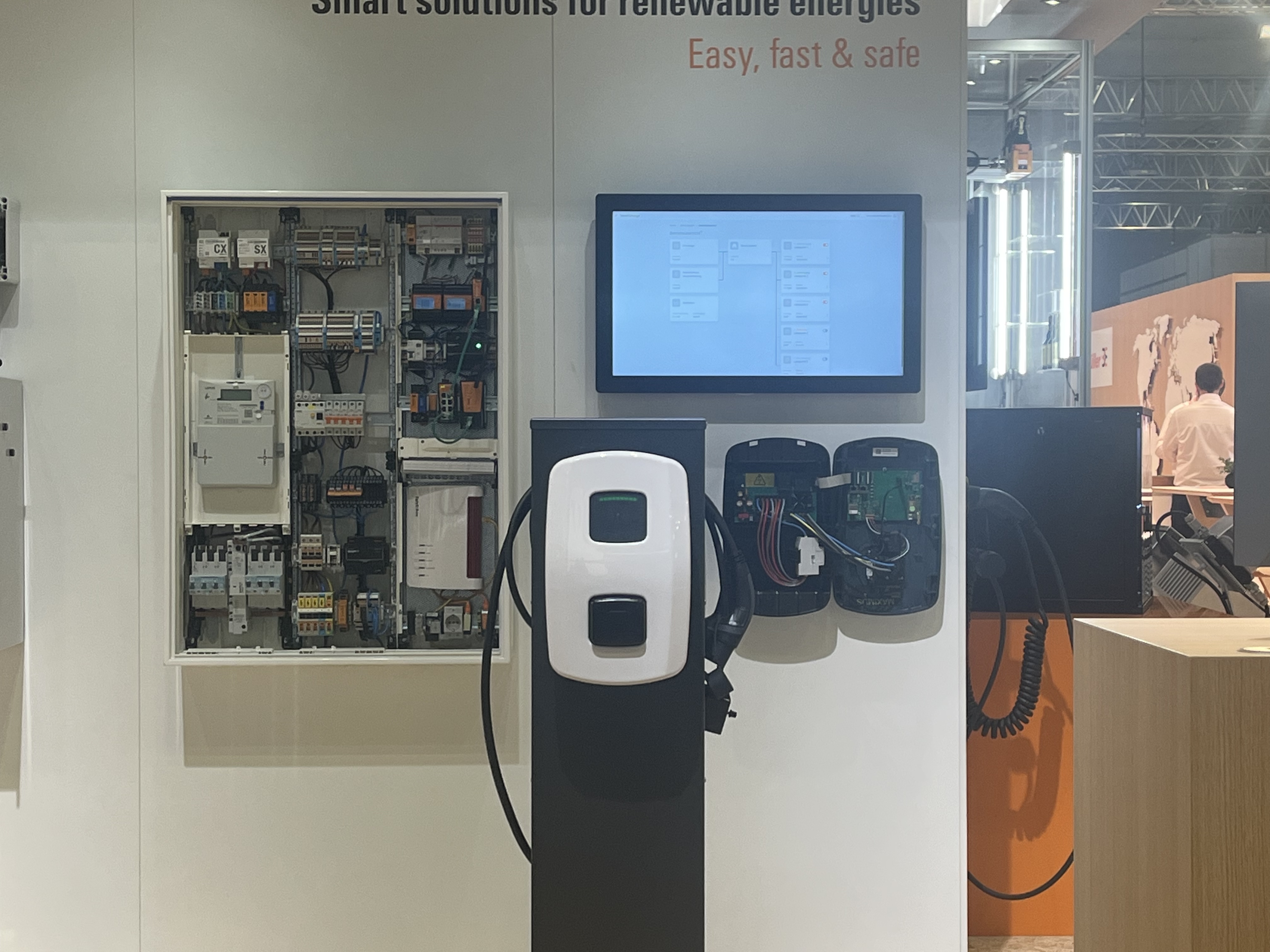
Capability verification starts with the hardware itself: format, parameters and the manufacturing evidence behind each model.
Why Capability Claims and Delivery Promises Have to Be Verified Separately
Supplier evaluation fails in two predictable ways. The first is accepting capability on the strength of a catalogue: a long product list is treated as proof of production depth, a CE logo is treated as covering every model in the range, and “customizable” is accepted without any statement of which parameters actually change. The second is accepting delivery on the strength of a quotation: a lead time is quoted without a capacity figure behind it, “100% tested” is stated without a definition of what the test covers, and acceptance criteria are agreed verbally — or not at all — before the purchase order is issued.
Both gaps surface late. A split-core CT whose window does not fit an existing busbar shows up as rework during a retrofit. A CT whose accuracy class does not match the meter’s specification shows up as an unexplained deviation in readings. A supplier that cannot hold capacity shows up as a delayed panel build, a delayed meter production run, or a delayed commissioning date. None of these risks is visible in a price comparison, and none of them is resolved by a supplier’s brand size alone.
The Standards and Market Context That Sets the Verification Baseline
Verification works better when it is anchored to an external reference rather than to a supplier’s own claims. For inductive current transformers, that reference is IEC 61869-2, which replaced IEC 60044-1 as the core international standard and defines accuracy classes such as 0.5 and 0.5S. Every certificate a supplier presents should be readable against that standard family, because the standard is what defines what an accuracy class actually means in service.
Billing applications raise the bar further. Revenue-grade current transformers are required to meet ANSI C12.20 or IEC 61869-2 accuracy classes — typically 0.2 or 0.15 — for utility billing applications. A supplier that cannot show model-level evidence at that class is not a candidate for revenue metering, regardless of how complete the rest of the range looks.
The commercial context explains why supplier-level verification matters more than it did a decade ago. The global current transformer market was estimated at USD 2.63 billion in 2024 and is projected to reach USD 3.90 billion by 2030, according to Grand View Research. Asia Pacific dominated that market with a 40.15% revenue share in 2025, based on Straits Research data. Split core current transformers are identified as the fastest-growing segment, driven by ease of installation in retrofitting and smart grid applications, according to Fact.MR.
Demand is also shifting by application. The global EV charging transformer market, which includes current monitoring components, is expected to grow at a CAGR of 23.6% from 2025 to 2033, based on Research Intelo data — a figure that reflects how much residual current and DC leakage sensing now sits inside charging infrastructure.
At the same time, the market is only partly concentrated. The top five global players — ABB, Siemens, GE, Schneider Electric and Arteche — collectively held approximately 40% of current transformer market share in 2024, according to Global Market Insights. The remaining share is served by specialist manufacturers. That specialist base is what most buyers actually shortlist, which is exactly why a structured evaluation method carries more weight than brand familiarity.
A Three-Layer Capability Verification Framework
Capability can be verified in three layers, in this order: the portfolio, the certification evidence, and the mapping between the two and the target market. The worked example below uses HEYI ELECTRICAL (Wenzhou Heyi Electrical Co., Ltd), a manufacturer of current transformers and current sensors founded in 2012 in Wenzhou, Zhejiang, China, operating a 10,000 m² facility with 56 employees, a five-engineer R&D team and a 95% export ratio across Southeast Asia, South Korea, Europe, South America, Australia, Africa, the Middle East and North America. The method itself is supplier-neutral and can be applied to any candidate.
Layer 1 — Audit the portfolio by format and parameter envelope
The first question is not “how many products do you have”, but “which formats are standard products, and what is the parameter envelope of each”. Format coverage determines whether a supplier can serve an application without a new tooling cycle. The following envelope is a documented example of what that information looks like when it is complete:
- Split-core current transformers — KCT series: 0–1000 A measurement range, 5 A / 1 A / mA / mV / RS485 / 4–20 mA outputs, accuracy 3.0 / 1.0 / 0.5, inner diameter 0–50 mm. Busbar split-core DP/HK: 0–8000 A, accuracy 3.0 / 1.0 / 0.5, inner diameter 0–80 × 160 mm. KCD smart split-core CT with RS485 output.
- Solid-core, window and busbar CTs — MSQ plastic-cased square window CT: 0–6000 A, accuracy 1.0 / 0.5 / 0.5S / 0.2 / 0.2S, inner diameter 0–125 mm. SDH window/busbar CT: 0–10,000 A, inner diameter 0–220 × 80 mm. CP compact DIN-rail CT: 0–6000 A, inner diameter 0–100 × 31 mm. DX/DM DIN-rail CT: 0–6000 A, inner diameter 125 × 35 mm.
- Three-phase current transformers — DASN 3-in-1 DIN-rail three-phase CT: 0–1000 A, 5 A output, accuracy 1.0, inner diameter 0–50 mm.
- Outdoor current transformers — OCT outdoor waterproof split-core CT: 0–8000 A, IP65, UV protection, inner diameter 0–120 mm. LMZW outdoor resin-cast CT: 0.66 kV, 0–1000 A, accuracy 1.0 / 0.5 / 0.5S / 0.2 / 0.2S, IP65, inner diameter 0–80 mm.
- Sensors and transmitters — HYCA residual current sensor for EV charging. C2/C3 split-core Hall Effect current sensor: 0–1000 A. KCT-L true RMS current transformer/transmitter: 0–1000 A, 4–20 mA output, accuracy 1.0.
- Rogowski coils — FRC flexible Rogowski coil: 100–10,000 A, inner diameter 245 mm, mV output.
Materials belong inside the audit, not outside it. The core material — silicon steel sheet, ferrite or nanocrystalline — influences saturation behaviour and cost; the housing material, whether PA, PC or ABS/PC, influences mechanical and environmental performance; and the winding in the products listed above is pure copper enameled wire. A supplier that can name its core and housing materials model by model is materially easier to audit than one that cannot.
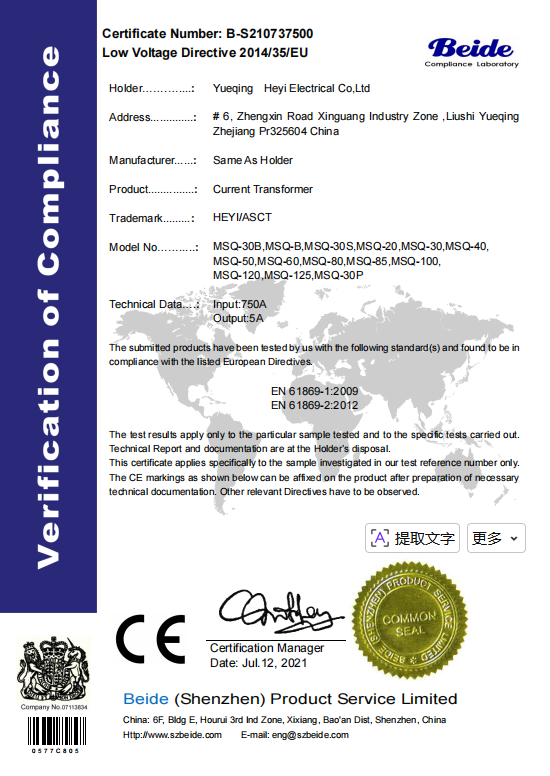
MSQ plastic-cased square window CT: 0–6000 A, inner diameter 0–125 mm, accuracy classes up to 0.2S.
Layer 2 — Cross-check certification evidence document by document
Certificates are scope-specific instruments. Before accepting any of them, ask for four data points per document: the certificate type, the issuing body and certificate number, the standard or directive referenced, and the exact model or product list covered. A CE mark displayed on a website is not evidence; a numbered attestation naming your model is.
| Evidence type | Issuing body | Reference number | Standard / directive | Verified scope |
|---|---|---|---|---|
| CE-LVD Attestation of Conformity | TÜV SÜD Product Service GmbH | N8A 114572 0001 Rev. 00 | CE-LVD (2014/35/EU); EN 61869-1, EN 61869-2 | Current transformer, model MSQ |
| CE-LVD Attestation of Conformity | TÜV SÜD Product Service GmbH | N8A 114572 0002 Rev. 00 | CE-LVD (2014/35/EU); EN 61869-1, EN 61869-2 | Busbar split-core current transformer, model DP/HK |
| CE-LVD Verification / Certificate | Beide (Shenzhen) Product Service Limited | B-S2410C4272; B-S210737499; B-S210737500 | EN 61869-1:2009, EN 61869-2:2012 | Models MSQ and CP |
| CE-LVD Attestation of Conformity | UDEM International Certification | M.2023.206.C90639 | IEC 62752:2016/A1:2018, IEC 62955:2018 | Fluxgate residual current sensor, model HYCA |
| CE-EMC Verification of Conformity | Beide (Shenzhen) Product Service Limited | B-E2505D2378 | EN IEC 61000-6-3:2021, EN IEC 61000-6-1:2019 | Current transformer, model DP/HK |
| RoHS evidence (certificate, attestation, test report) | Authorised by Nico Xie / Manager; Ningbo LCS Standard Technology Service Co., Ltd.; Shenzhen LCS Compliance Testing Laboratory Ltd. | GST.210923.S201R; LCSE03115005R; LCSA03054058R | 2011/65/EU, (EN)2015/863; IEC 62321 series | KCT, KCD, KCT-L and the HYCA residual current sensor |
| UKCA Declaration of Conformity | Shanghai Global Testing Services Co., Ltd. | CLZJ23072649108 | BS EN 61869-2:2012 | KCT, KCD, KCT-L (valid to 26 July 2028) |
| Type Test Report | Zhejiang Fangyuan Test Group Co., Ltd | 25133Z40179 | IEC 61869-1, IEC 61869-2 | Model LMZW outdoor current transformer |
| Type Test Report | Suzhou Electrical Apparatus Science Research Institute Co., Ltd | 25T0221-S | IEC/EN 61869 series | Model RECT |
| IP Code Test Report | Shenzhen Qstlab Testing Co., Ltd. | Qst-23N020111-1SR | IEC 60529:1989+A1:1999+A2:2013 | Outdoor waterproof split-core CT, model OCT (IP65) |
| ISO 9001:2015 Certificate | Quality management system certificate | 20224Q21295R0S | GB/T 19001-2016 / ISO 9001:2015 | Production of low-voltage current transformers (valid to 20 November 2027) |
| Metrological Verification Certificate | Yueqing Institute of Quality and Technical Supervision Inspection | D20250900173 | JJG 313-2010 | Standard current transformer with current booster, model HLS21-2S, ratio 5A/5A–2000A/5A |
Read the scope column, not the headline. A CE-LVD attestation issued for model DP/HK does not automatically extend to every split-core product in the catalogue, and a UKCA declaration referencing BS EN 61869-2:2012 covers the models named in it. Two further points are worth checking on the same pass. First, validity: the UKCA declaration above expires on 26 July 2028, the ISO 9001 certificate on 20 November 2027, and several CE-LVD documents carry 2027–2028 expiry dates — a renewal calendar is part of supplier risk management. Second, test equipment: calibration and verification certificates for a current load box (model HL04, JJF 1264-2010), a withstand voltage tester (model BF2670AM, JJG 795-2016) and a standard current transformer with current booster indicate that the supplier’s own measurement chain is periodically verified, which is what makes routine test results meaningful.
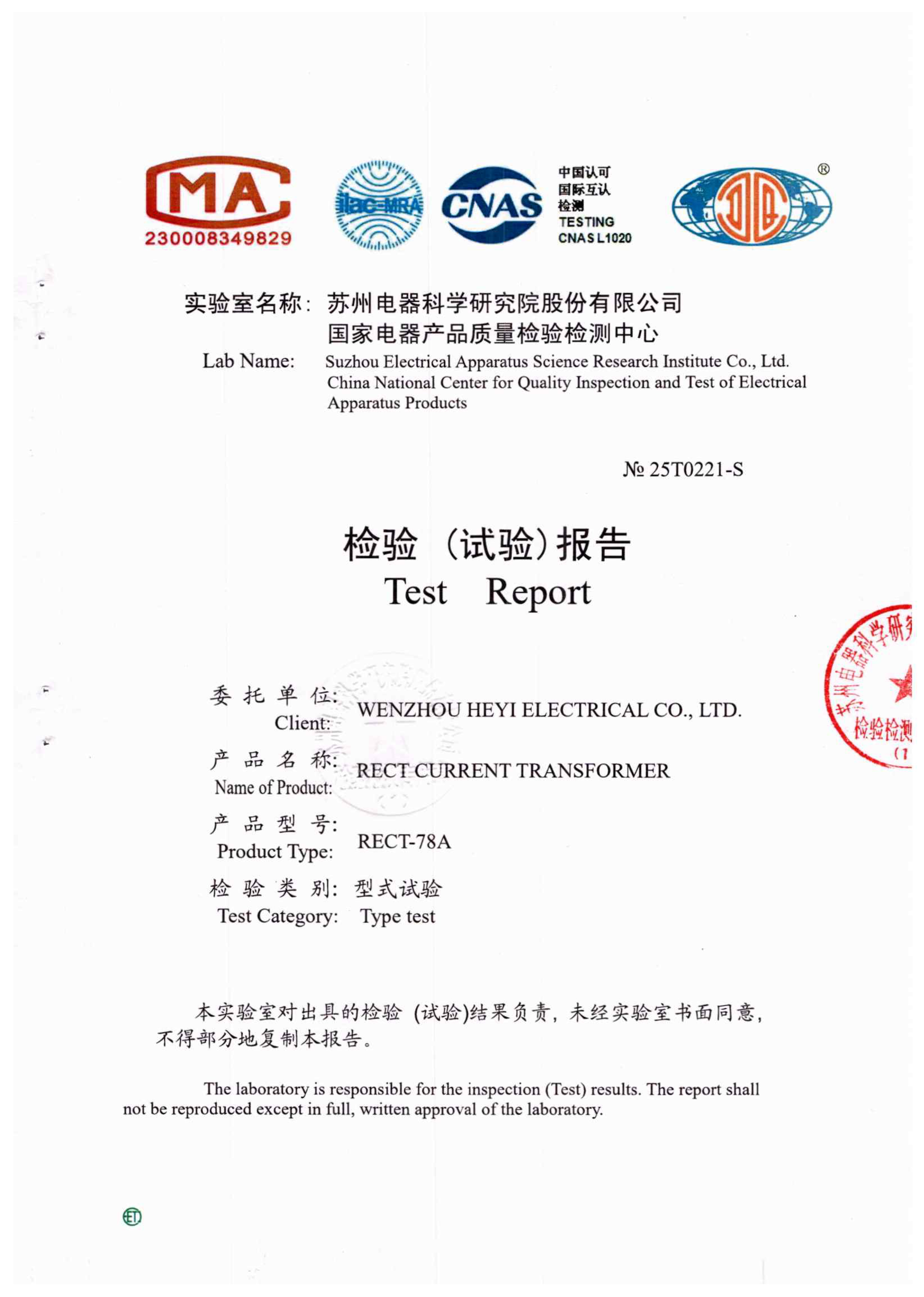
Type test reports are model-specific: report 25T0221-S applies to the RECT extended-range revenue CT.

ISO 9001:2015 certificate 20224Q21295R0S covers the production of low-voltage current transformers.
Layer 3 — Map credentials to the target market and application
The third layer converts evidence into a market decision. The same product family may need different documents depending on where it is installed and what it is used for.
| Target market or requirement | Evidence to request | Verified example |
|---|---|---|
| European Union (CE marking) | CE-LVD, CE-EMC and RoHS documentation covering the exact model | MSQ and DP/HK (LVD); DP/HK (EMC); KCT, KCD, KCT-L (RoHS) |
| United Kingdom | UKCA declaration referencing BS EN 61869-2 | KCT, KCD, KCT-L, valid to 26 July 2028 |
| Utility billing / revenue metering | Accuracy class 0.2 or 0.15 evidence under IEC 61869-2 or ANSI C12.20 | RECT: 0.15S, IEEE C57.13, type test 25T0221-S |
| Outdoor or overhead-line installation | IP65 test report and UV protection statement | OCT (IP65 test to IEC 60529); LMZW (IP65, type test to IEC 61869-1/-2) |
| EV charging leakage protection | CE-LVD referencing IEC 62752 and IEC 62955 | HYCA residual current sensor (M.2023.206.C90639) |
| Quality system requirement | ISO 9001:2015 certificate with a scope covering CT production | 20224Q21295R0S, valid to 20 November 2027 |
Step-by-Step Supplier Evaluation Workflow
The three layers translate into an eight-step sequence that can be run before any purchase order is issued.
- Define the application envelope. Fix the format, current range, inner diameter or window size, output type, accuracy class and environment before talking to suppliers. An envelope that is not defined cannot be verified.
- Request model-level documentation. Ask for the specification, dimensions, wiring information and output definition for the exact model, not the product family.
- Request the full certification file with scope statements. Certificate type, issuing body, certificate number, standard and covered models — in one package.
- Cross-check scope against model and market. Confirm that the document names your model and matches your destination market, then diarise the expiry date.
- Verify the customization range. Documented customization options include current ratio, accuracy class, burden, window size, housing color, terminal type, cable length, logo printing and label design, supported by OEM, ODM, customized production and bulk manufacturing modes.
- Verify the quality control routine. Ask which tests are applied to every unit: 100% routine test, accuracy test, insulation resistance test, withstand voltage test, appearance inspection and pre-shipment inspection.
- Verify the delivery parameters. Request the monthly capacity, the lead time window, the minimum order quantity, the delivery terms and the payment terms in writing.
- Fix acceptance criteria before production. Agree how the goods will be accepted — video or photographic acceptance, on-site acceptance, or acceptance by a commissioned third-party agency — and write it into the order.
| Verification dimension | Question to ask | Acceptable form of evidence |
|---|---|---|
| Portfolio depth | Which formats are standard products with fixed parameter envelopes? | Model-level specification with range, accuracy and dimensions |
| Certification coverage | Which certificate covers this model in this market? | Numbered certificate with scope statement and validity date |
| Customization | Which parameters can be changed, and to what limits? | Written customization option list per model |
| Quality control | What is tested on every unit before shipment? | Named test list plus routine test records |
| Capacity and lead time | How many units per month, and how many days to ship? | Stated capacity figure and lead time window |
| Acceptance and support | How are goods accepted, and what happens after delivery? | Agreed acceptance method and after-sales terms |
Use Cases: Where Verified Capability Changes the Outcome
Metro and elevator energy monitoring
Rail and vertical-transport monitoring needs a split-core CT that can be installed around existing conductors without interrupting service, and that returns digital data rather than an analogue output. The KCD smart split-core current transformer combines a 0–1000 A range with RS485 output and is referenced in applications including Beijing and Hangzhou metro lines, elevator monitoring, smart building and property management, green building energy conservation, O&M services and smart factory retrofit. This is where delivery assurance matters as much as the specification: retrofit schedules rarely tolerate a late shipment.
PV string, battery storage and VFD DC bus monitoring
Solar and storage projects increasingly measure DC as well as AC. The C2/C3 split-core Hall Effect current sensor covers a 0–1000 A range and is referenced for PV string monitoring, BMS and battery storage, VFD DC bus monitoring, railway traction, renewable energy and industrial automation. In this application, buyers should verify that the sensor’s active electronics and zero/span adjustment are covered by the same quality routine as the passive CTs in the range.
EV charger leakage protection
Charging infrastructure adds a safety-critical sensing layer that most CT catalogues do not cover. The HYCA residual current sensor operates over a DC frequency range up to 2 kHz, carries a load current of up to 80 Arms single-phase or 3 × 32 Arms three-phase, provides switching outputs for 6 mA DC and 30 mA AC in accordance with IEC 62752, includes integrated self-monitoring and test functions, and offers a measurement resolution of 0.2 mA with a differential current range of 0–300 mA. Its compliance evidence is specific: CE-LVD attestation M.2023.206.C90639 referencing IEC 62752:2016/A1:2018 and IEC 62955:2018, plus RoHS attestation LCSA03054058R.
Outdoor grid, overhead line and utility billing
Outdoor installations combine electrical and environmental requirements. The OCT outdoor waterproof split-core CT covers 0–8000 A at IP65 with UV protection and an inner diameter up to 120 mm, supported by IP65 test report Qst-23N020111-1SR to IEC 60529. The LMZW outdoor resin-cast CT is rated for 0.66 kV with IP65 protection and is covered by type test report 25133Z40179 to IEC 61869-1 and IEC 61869-2. For revenue billing, the RECT extended-range CT is specified at 0.15S accuracy to IEEE C57.13 with IP65 protection, supported by type test report 25T0221-S.

IP65 test report Qst-23N020111-1SR covers the OCT outdoor waterproof split-core current transformer.
Delivery Assurance: The Half of the Evaluation Buyers Skip
Delivery assurance is verifiable in the same way capability is. The parameters below are the ones to request in writing, because each one converts a promise into a commitment that can be measured after the fact.
- Production capacity and mode — monthly production capacity of 20,000 units, produced under OEM, ODM, customized production and bulk manufacturing modes.
- Lead time — a typical production lead time window of 3–30 days, which allows buyers to plan around the upper bound rather than the best case.
- Minimum order quantity — MOQ of 1 unit, which makes single-unit evaluation orders feasible before a production commitment.
- Quality control — 100% routine test, accuracy test, insulation resistance test, withstand voltage test, appearance inspection and pre-shipment inspection on every order.
- Commercial terms — delivery terms FOB, CIF or EXW; payment terms T/T, AliPay, Alibaba and PayPal.
- Acceptance method — acceptance via video or photographs, with on-site acceptance or acceptance by a commissioned third-party agency also available.
- After-sales support — technical selection support, wiring guidance, product replacement support, OEM documentation support and online after-sales service.
Delivery assurance should also be checked against actual deployment history rather than intent. The documented customer base for this product range includes power utility companies, electrical engineering contractors, panel builders, industrial equipment manufacturers and building energy management integrators, with projects located in countries including Thailand, Chile, Lebanon, South Korea, Australia, Costa Rica, Sri Lanka, Ecuador, Morocco, the Philippines, the Dominican Republic, Tunisia, Botswana and Zimbabwe, across a supply duration of 10 years. Reported project outcomes are consistent with what a verified CT range should deliver: improved current measurement accuracy, stable energy metering, reduced installation difficulty in retrofit projects, enhanced electrical system monitoring, and the ability for engineers to identify abnormal load conditions.
Frequently Asked Questions
1. How do I confirm that a current transformer supplier’s CE and UKCA certificates actually cover the model I am buying?
Verify the scope statement, not the logo. Ask for four data points on every certificate: certificate type, issuing body and number, the standard referenced, and the exact model or product list covered. In a documented example, CE-LVD attestations issued by TÜV SÜD Product Service GmbH under N8A 114572 0001 Rev. 00 and N8A 114572 0002 Rev. 00 reference EN 61869-1 and EN 61869-2 and cover models MSQ and DP/HK respectively, while CE-LVD verification B-S2410C4272 from Beide (Shenzhen) Product Service Limited covers MSQ to EN 61869-1:2009 and EN 61869-2:2012. The UKCA declaration CLZJ23072649108, issued to BS EN 61869-2:2012, covers KCT, KCD and KCT-L and remains valid to 26 July 2028. RoHS evidence is also model-linked: GST.210923.S201R covers KCT, KCD and KCT-L, and LCSA03054058R covers the HYCA residual current sensor. Always check the expiry date as well as the scope.
2. What product and customization capability should an OEM current transformer supplier be able to demonstrate?
A supplier should be able to name standard formats with fixed parameter envelopes and state exactly which parameters are customizable. In the documented example, standard formats include split-core CTs (KCT, 0–1000 A; DP/HK busbar split-core, 0–8000 A), solid-core and DIN-rail CTs (MSQ and CP, 0–6000 A; SDH, 0–10,000 A; DX/DM, 0–6000 A), three-phase CTs (DASN, 0–1000 A with 5 A output), outdoor CTs (OCT IP65, 0–8000 A; LMZW 0.66 kV, 0–1000 A), the C2/C3 Hall Effect current sensor (0–1000 A), the HYCA residual current sensor, the FRC flexible Rogowski coil (100–10,000 A) and the KCT-L true RMS transmitter (0–1000 A, 4–20 mA). Customization covers current ratio, accuracy class, burden, window size, housing color, terminal type, cable length, logo printing and label design, delivered through OEM, ODM, customized production and bulk manufacturing modes.
3. What drives the cost and minimum order quantity when ordering current transformers?
Cost is driven mainly by configuration rather than by catalogue position. The relevant variables are mechanical format, core material (silicon steel sheet, ferrite or nanocrystalline), accuracy class up to 0.2S and higher, inner diameter or window size, output type (5 A, 1 A, mA, mV, RS485 or 4–20 mA), housing material (PA, PC or ABS/PC), and the depth of customization requested across ratio, accuracy class, burden, window size, housing color, terminal type, cable length, logo printing and label design. Quantity obviously scales the commercial picture. On the commercial side, the stated minimum order quantity is 1 unit, delivery terms are FOB, CIF or EXW, and payment terms include T/T, AliPay, Alibaba and PayPal — which means a buyer can evaluate a configuration at low commitment before scaling.
4. Can a single unit be ordered as a sample, and how is acceptance handled?
Yes — the stated minimum order quantity is 1 unit, so a single unit can be ordered for evaluation, and the typical production lead time window of 3–30 days applies. Acceptance can be handled through video or photographic verification, and on-site acceptance or acceptance by a commissioned third-party agency are also available as options. Agreeing the acceptance method in writing before production is the single most effective way to avoid disputes later, because it converts “quality” from an opinion into a defined procedure that both sides have already accepted.
5. What lead time and production capacity can be expected, and how do I start?
Typical production lead time is 3–30 days, with a stated monthly production capacity of 20,000 units and a quality management system certified to ISO 9001:2015 (certificate 20224Q21295R0S) covering the production of low-voltage current transformers. Every order passes 100% routine test, accuracy test, insulation resistance test, withstand voltage test, appearance inspection and pre-shipment inspection. To start an evaluation, send your application envelope — format, current range, window size, output, accuracy class and target market — and request a sample, a quotation and the relevant certification file for the exact model.
Conclusion: Evaluate Capability and Delivery as One System
A current transformer supplier is only as reliable as the weaker of two systems: the capability system that determines whether the right product can be built and certified, and the delivery system that determines whether it arrives on time and to an agreed standard. Auditing a portfolio without auditing certificates leaves scope risk. Auditing certificates without auditing capacity, lead time and acceptance terms leaves schedule risk. Auditing both, against a defined application envelope and a documented evidence set, is what turns a supplier shortlist into a sourcing decision.
The practical takeaway is a short checklist: define the envelope, request model-level specifications, request numbered certificates with scope and expiry dates, confirm customization limits in writing, confirm the quality control routine, confirm capacity and lead time, and agree the acceptance method before the purchase order is signed.
Next Step: Request a Sample, Quote or Full Documentation Set

HEYI ELECTRICAL (Wenzhou Heyi Electrical Co., Ltd) supplies current transformers, current sensors and transmitters with a minimum order quantity of 1 unit and a 3–30 day production lead time. Buyers can request a sample or quotation, ask for the certification file covering a specific model, or download the product catalogue before committing to a production order.
Download the catalogue: HEYI product brochure (PDF)
Website: www.heyiele.com
Email: bethy@heyiele.com
WhatsApp / Tel: +86 13968747975
Address: 5 Floor, Building 2, No.56 Nirong Middle Road, Kunpeng Street, Wenzhou Marine Economy Development Demonstration Zone, Wenzhou City, Zhejiang, China
Have Questions or Need More Details?
Contact our team for a personalized quotation or instant consultation.
Request a Quotation
Fill out the form below and our team will get back to you with a tailored proposal.
WhatsApp Direct Chat
Prefer to chat in real-time? Message us on WhatsApp for instant assistance & quick answers.
- Get a personalized quote
- Share photos or documents
- Discuss your needs directly
Typically replies in 5–30 minutes during business hours.