
Ranking 5 Current Transformers for Harsh Installation Conditions
A current transformer for a harsh installation is not chosen by accuracy class alone. It is chosen by three constraints first: the certified ingress protection rating, the mounting and mechanical architecture, and the insulation and housing material. This ranking shortlists five models for high-vibration DIN-rail panels, exposed outdoor mounting, and retrofit work on busbars that cannot be disconnected — and explains the inclusion rationale, the supporting documentation, and the limits of each.
What Counts as a Harsh Installation Condition
A “harsh” installation is defined by what the environment does to the transformer, not by how difficult the job feels. Four pressure groups drive almost every specification change.
- Mechanical stress. Continuous vibration and shock — electrification units and high-speed rail, construction and mining machinery, modular and prefabricated systems — cause loose terminals, cracked housings, and drifting secondary connections.
- Environmental exposure. Rain, high humidity, salt-laden coastal air, and ultraviolet radiation degrade plastic housings, corrode cores, and change insulation performance over time. Overhead line monitoring, municipal infrastructure, railway trackside, marine and offshore, and ring main units belong here.
- Installation constraints. Retrofit projects frequently cannot disconnect the primary conductor. Confined busbar runs leave very little space for the sensing element or the installer’s hands.
- Access and maintenance constraints. If a device is mounted on a pole, a trackside cabinet, or an offshore skid, a re-visit is expensive. The first installation has to be right.
Each of these pressure groups eliminates a different family of current transformers. A standard indoor square-window plastic CT is the correct choice for a clean distribution panel and the wrong choice on an overhead line. A split-core clamp-on unit solves the retrofit problem and may not solve the accuracy problem. Ranking models therefore only makes sense against a defined job site.
Why Harsh-Condition CT Selection Has Become Its Own Buying Decision
Two market movements have pushed environmental and mechanical constraints to the front of the specification sheet.
First, the installed base of current transformers is being replaced rather than newly built. The global current transformer market was estimated at USD 2.63 billion in 2024 and is projected to reach USD 3.90 billion by 2030, according to Grand View Research. A large portion of that value sits in distribution and monitoring applications rather than greenfield switchgear. Straits Research placed Asia Pacific at a 40.15% revenue share of the current transformer market in 2025, which reflects both manufacturing concentration and the density of retrofit and smart-grid programmes in the region.
Second, retrofit is structurally different from new build. Fact.MR identifies split core current transformers as the fastest-growing segment, and attributes that growth to ease of installation in retrofitting and smart grid applications. That is a mechanical argument, not an electrical one: clamping around an existing conductor avoids the outage cost of disconnecting it.
On the compliance side, IEC 61869-2 (which replaced IEC 60044-1) is the core international standard for inductive current transformers and defines accuracy classes such as 0.5 and 0.5S. For billing-grade work, revenue grade current transformers are required to meet ANSI C12.20 or IEC 61869-2 accuracy classes, typically 0.2 or 0.15, as set out in Eaton’s metering accuracy guidance. Selection for harsh environments therefore runs on two tracks at once: mechanical survivability and documented electrical compliance.
Note on scope: no market is served exclusively by its largest suppliers. Global Market Insights estimated that the top five global players held approximately 40% of current transformer market share in 2024, which leaves the majority of the market to specialist manufacturers who compete on configuration, protection rating, and delivery rather than on scale.
Five Selection Criteria That Decide the Shortlist
1. Certified ingress protection, not a claimed IP rating
An IP rating is a test result, not a design intention. Under IEC 60529, the first digit describes protection against solid objects and dust, and the second digit describes protection against water. IP65 combines dust-tight construction with protection against water jets; IP67 adds protection against temporary immersion.
The practical buying rule: ask for the certificate number, the standard revision, and the issuing laboratory. The OCT outdoor split-core current transformer, for example, holds an IP65 certification numbered Qst-23N020111-1SR, issued by Shenzhen Qstlab Testing Co., Ltd. under IEC 60529:1989+A1:1999+A2:2013 — a checkable fact, not a catalogue adjective. Where a product description lists a range such as “IP65/IP67 rated”, buyers should confirm which specific rating is certified on the model they are ordering.
2. Mounting architecture and mechanical retention
Three architectures cover harsh installations, and each solves a different problem.
- DIN-rail with hinged terminal covers and plug-in secondary terminals — the right answer for vibration, because the connection is retained by the mounting system rather than by a cable gland alone.
- Split-core clamp-on — the right answer for retrofit and for confined geometry, because the conductor does not have to be disconnected or re-routed.
- Solid-core resin cast — the right answer for permanent outdoor exposure, because there are no mating surfaces to seal.
3. Insulation and housing material
Material determines how the device behaves after years of moisture and UV. Hydrophobic epoxy resin cast bodies resist surface moisture tracking; plastic housings with epoxy resin potting combine a mechanical shell with an encapsulated core. ABS/PC and PA/PC housings are appropriate for protected panel interiors and should not be read as outdoor materials.
4. Window geometry versus the actual conductor
Window dimensions are a hard constraint, not a preference. A round window suits cables and overhead conductors; a rectangular window suits laminated busbar. A busbar that does not physically pass through the aperture cannot be measured, regardless of accuracy class.
5. Documentation that matches the destination market
An outdoor current transformer shipped into the EU needs its compliance file to travel with it. Relevant document types include CE-LVD attestations, CE-EMC verification, RoHS test reports, UKCA declarations, and third-party type test reports. An ISO 9001:2015 quality management certificate covering low-voltage current transformer production supports the manufacturing claim but is not a product compliance document, and the two should not be confused.
Step-by-Step: How to Build and Validate a Shortlist
- Classify the site condition. Write down the dominant stress: vibration, weather, retrofit access, or confined geometry. A site usually has one dominant stress and one secondary stress.
- Set the minimum protection requirement. For directly exposed outdoor mounting, set a minimum IP65 with documented UV protection. For panel interiors, ingress protection is secondary to mechanical retention and thermal behaviour.
- Choose the mounting architecture from the three families above. This step eliminates most of the catalogue before any electrical comparison begins.
- Match the window to the conductor. Measure the conductor or busbar, then compare with the published inner diameter — for example 0–120 mm on the OCT, 0–80 mm on the LMZW, 125×35 mm on the DX/DM, or 0–80×160 mm on the DP/HK busbar split-core model.
- Confirm the electrical fit. Check measurement range, secondary output, and accuracy class against the application. Monitoring-grade outdoor work typically needs 1.0 or better; revenue billing needs 0.2S or 0.15S on a compliant platform.
- Collect the document pack. Request the certificate numbers and the standards they reference before issuing the purchase order, and confirm that the certificate scope names the model you are buying.
The Ranking: Five Recommended Current Transformers
How this ranking was built: the five models below are ordered by fit for harsh installation conditions — specifically the combination of certified ingress protection, mounting architecture, material selection, and available third-party documentation. This is not an overall quality ranking of the manufacturer’s catalogue. A different job site reorders the list, and that is the point of the closing guidance.
Rank 1 — OCT Outdoor Waterproof Split-Core Current Transformer
Best fit: exposed outdoor mounting + retrofit without disconnection
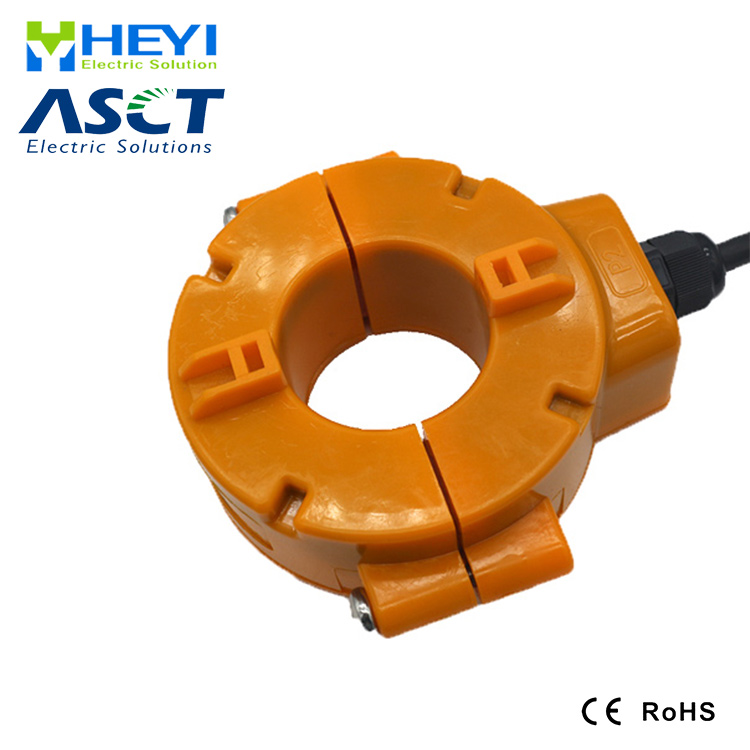
The OCT ranks first because it is the only model in this shortlist that combines a certified outdoor ingress rating with a split-core clamp-on architecture. That combination covers the two hardest constraints at once: weather exposure and the inability to disconnect the primary conductor.
Inclusion rationale and verified specifications:
- Product type: outdoor waterproof split-core CT; IP65/IP67-rated split-core transformer; overhead line monitoring CT; weatherproof clamp-on current sensor.
- Measurement range 0–8000 A; output 5 A / 1 A / mA / mV; accuracy 3.0 / 1.0 / 0.5.
- Inner diameter 0–120 mm, with UV protection and a published waterproof rating of IP65.
- Materials: plastic housing plus epoxy resin, silicon steel sheets, pure copper enameled wire.
- Customisable on OEM terms, including lead wire type, lead wire length, and connector.
- Ingress protection certified as IP65 (certificate Qst-23N020111-1SR, Shenzhen Qstlab Testing Co., Ltd., IEC 60529:1989+A1:1999+A2:2013, global market).
- Covered by CE-LVD Attestation of Conformity M.2023.206.C83963 (TÜV-listed UDEM International Certification Auditing Training Centre Industry and Trade Inc. Co.; standards IEC 60044-1:2003 and IEC 61869-2:2012; EU market; issued 2023-04-11, valid to 2028-04-10).
- Target applications: overhead line monitoring, outdoor solar and wind, municipal infrastructure, railway trackside.
Where it is not the right answer. The published accuracy classes for this model are 3.0, 1.0 and 0.5. If the project requires 0.2S or 0.15S revenue-grade accuracy, the LMZW (up to 0.2S) or the RECT (0.15S) cover that requirement instead. Buyers should also verify that the conductor fits the 0–120 mm aperture before ordering.
Rank 2 — LMZW Outdoor Resin-Cast Solid-Core Current Transformer
Best fit: permanent outdoor installation, marine and offshore, high humidity
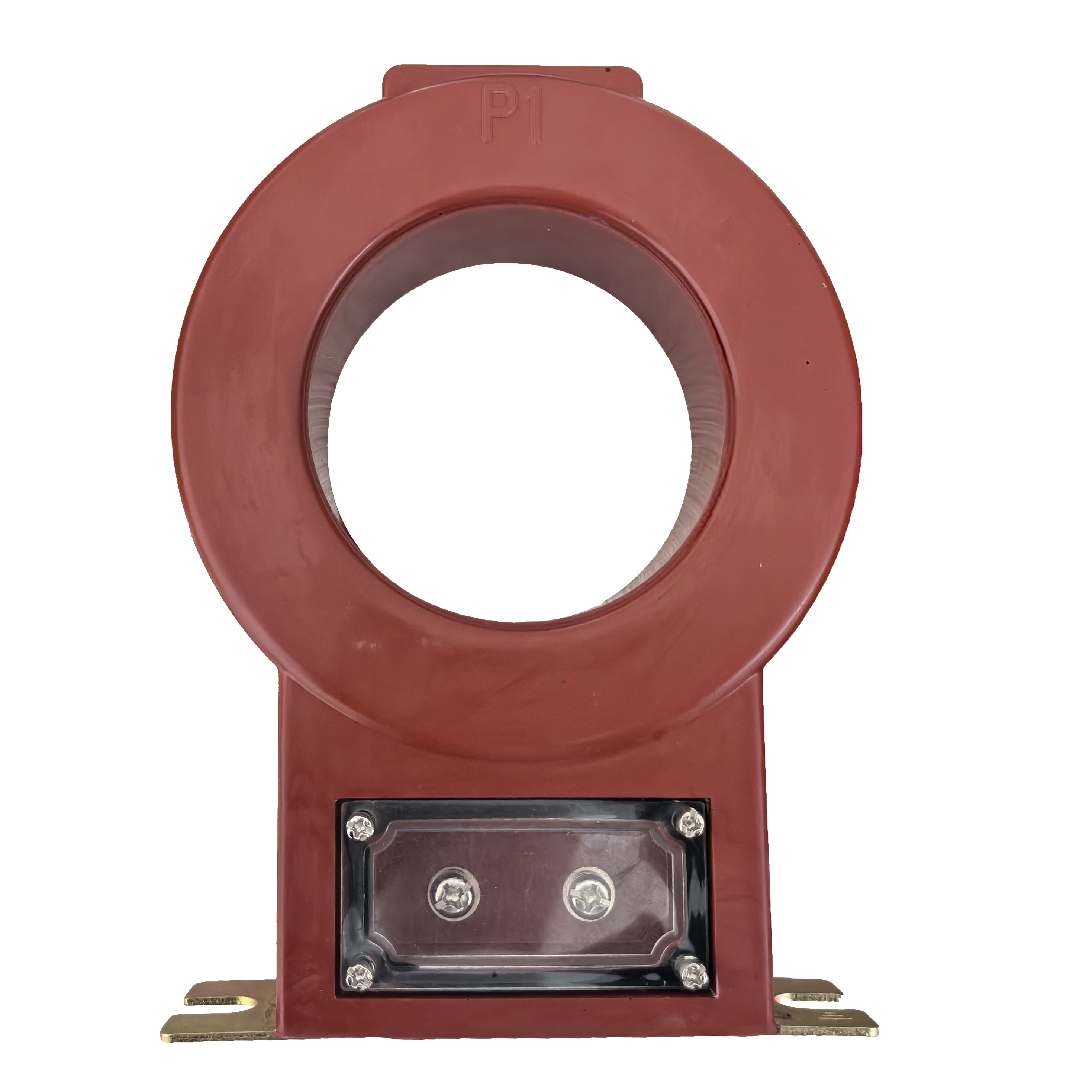
The LMZW ranks second overall but first for any installation that will never be serviced under cover. It is a solid-core unit cast in hydrophobic epoxy resin — the format that removes gaskets, mating faces, and joints from the moisture path.
Inclusion rationale and verified specifications:
- Product type: outdoor resin-cast current transformer; epoxy cast resin busbar CT; 0.66 kV weatherproof solid-core CT; moisture-proof low voltage CT.
- Measurement range 0–1000 A; output 5 A / 1 A / mA / mV.
- Accuracy 1.0 / 0.5 / 0.5S / 0.2 / 0.2S — the widest accuracy span in this shortlist.
- Inner diameter 0–80 mm, with UV protection and a published waterproof rating of IP65; OEM customisation available.
- Materials: hydrophobic epoxy resin, silicon steel sheet, pure copper enameled wire.
- Covered by Type Test Report 25133Z40179 (Zhejiang Fangyuan Test Group Co., Ltd.; standards IEC 61869-1 and IEC 61869-2; global market).
- Covered by CE-LVD Attestation of Conformity M.2023.206.C83963, applicable to the EU market.
- Target applications: marine and offshore, chemical and metallurgy, ring main units.
Trade-off to plan for. A solid-core transformer requires the primary conductor to be routed through the window during installation. It is the wrong choice for a live-busbar retrofit where the conductor cannot be opened, and it is usually the right choice where a fault caused by water ingress is the greater risk.
Rank 3 — DX/DM Compact Low Voltage DIN-Rail Current Transformer (0.66 kV)
Best fit: high-vibration panels, EMU and high-speed rail, modular and prefabricated systems
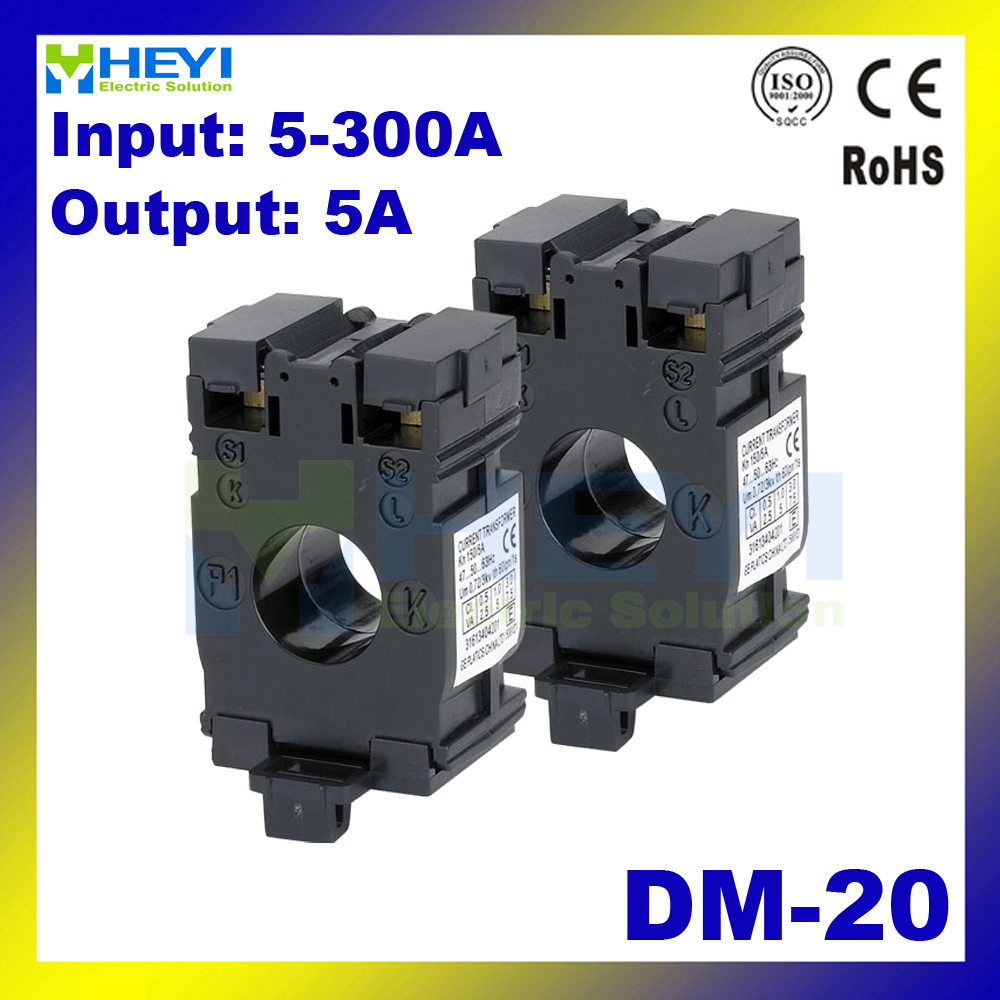
The DX/DM is included specifically for mechanical conditions rather than weather conditions. It is a compact low voltage 0.66 kV DIN-rail CT with a hinged terminal cover and plug-in (quick-connect) secondary terminals — a connection method that resists loosening under sustained vibration and reduces re-termination time during commissioning.
Inclusion rationale and verified specifications:
- Product type: DIN-rail mounted current transformer; compact low voltage CT (0.66 kV); hinged terminal cover CT; easy installation CT; plug-in terminal current transformer; quick-connect secondary CT.
- Measurement range 0–6000 A; output 5 A; accuracy 1.0 / 0.5; inner diameter 125×35 mm.
- Materials: ABS/PC plastic, silicon steel sheets or nanocrystalline materials, pure copper enameled wire.
- Manufacturing is covered by the ISO 9001:2015 quality management system certificate 20224Q21295R0S, whose scope is the production of low-voltage current transformers, valid until 2027-11-20.
- Target applications: EMU and high-speed rail, high-vibration environments, modular and prefabricated systems, construction and mining machinery, modular data centers.
Limits and boundaries. This model is engineered for protected panel interiors. It is not presented as an outdoor device: where the cabinet itself is exposed to driving rain or salt fog, the enclosure should carry the environmental rating and the CT should be selected for vibration and accuracy instead. Buyers should also confirm that the 125×35 mm window accommodates the specific busbar arrangement in the panel.

Rank 4 — DP/HK Busbar Split-Core Current Transformer
Best fit: confined busbar runs and retrofits where the conductor cannot be disconnected
The DP/HK is included for a geometry problem that no other model in this list solves: rectangular laminated busbar inside a congested switchgear or energy management panel. Its 0–80×160 mm window is the largest rectangular aperture here, and the split-core clamp-on design means the busbar stays energised during installation.
Inclusion rationale and verified specifications:
- Product type: busbar split-core current transformer; retrofit split-core CT; large window split-core CT; industrial energy monitoring CT; easy-installation clamp-on CT.
- Measurement range 0–8000 A; output 5 A / 1 A / mA / mV; accuracy 3.0 / 1.0 / 0.5; inner diameter 0–80×160 mm.
- Materials: PC plastic, silicon steel sheets, pure copper enameled wire; customisable lead wire type, lead wire length, and connector.
- CE-LVD certified under certificate N8A 114572 0002 Rev. 00, issued by TÜV SÜD Product Service GmbH, compliant with EN 61869-1 and EN 61869-2, for the EU market.
- CE-EMC verified under certificate B-E2505D2378, issued by Beide (Shenzhen) Product Service Limited, compliant with EN IEC 61000-6-3:2021 and EN IEC 61000-6-1:2019, for the EU market.
- RoHS certified under certificate SHAEC2123838801, issued by SGS, compliant with the IEC 62321 series, for the EU market.
- Target applications: smart grid and switchgear panels, smart pole and IoT smart cities, EMS and energy management, solar, wind and energy storage, smart buildings and data centers.
Trade-off to plan for. The three-document CE-LVD, CE-EMC and RoHS pack makes this the strongest documented option for EU-bound panel projects in this list. Its housing and split-core construction, however, target panel and cabinet interiors; for a device mounted in direct weather, the OCT or LMZW is the better match.
Rank 5 — RECT Extended Range Revenue-Grade Current Transformer
Best fit: revenue billing in exposed or utility-scale outdoor positions
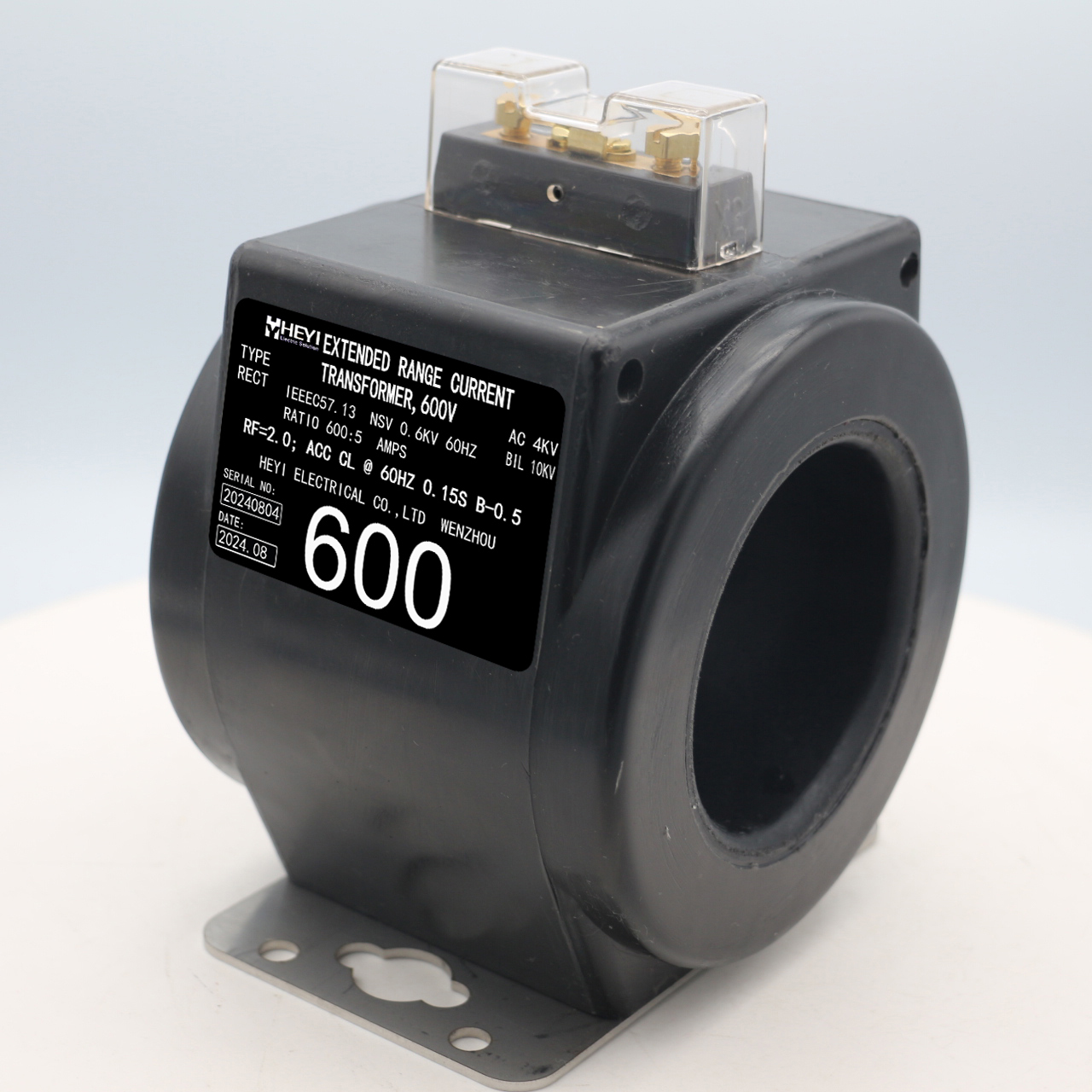
The RECT closes the shortlist because it addresses the combination that the other four do not: outdoor-rated construction plus billing-grade accuracy. It is a resin-insulated, anti-saturation extended range current transformer rated 0.15S and designed to IEEE C57.13.
Inclusion rationale and verified specifications:
- Product type: extended range current transformer (ERCT); revenue-grade billing CT; 0.15S high-accuracy resin-insulated CT; IEEE C57.13 compliant revenue CT; anti-saturation CT.
- Measurement range 0–1000 A; output 5 A / 1 A; inner diameter 0–78 mm.
- Waterproof rating IP65 with UV protection; epoxy resin insulation, silicon steel sheets, pure copper enameled wire; OEM customisation available.
- Covered by Type Test Report 25T0221-S, issued by Suzhou Electrical Apparatus Science Research Institute Co., Ltd., compliant with the IEC/EN 61869 series, for the global market.
- Target applications: utility and substation billing, utility-scale solar and wind plants, data center and commercial and industrial revenue sub-billing, premium meter OEM manufacturing.
Trade-off to plan for. This is a specification-driven model. Where a project only needs monitoring-grade data at class 1.0 outdoors, specifying 0.15S anti-saturation performance adds requirements to the purchase order that the application does not consume. Buyers should match the accuracy class to the commercial consequence of the measurement, not to the highest number in the catalogue.
Matching Model to Job Site: Application Scenarios
- Overhead line or pole-mounted monitoring: OCT — clamp-on installation, certified IP65, 0–120 mm aperture, UV protection.
- Railway trackside and outdoor municipal cabinets in wet climates: OCT for clamp-on access; LMZW where a sealed resin-cast body is preferred and the conductor can be routed.
- Marine, offshore and chemical plant: LMZW — hydrophobic epoxy resin cast, IP65, UV protection, accuracy options up to 0.2S.
- High-speed rail, mining machinery and prefabricated power modules: DX/DM — hinged terminal cover, plug-in secondary terminals, 0.66 kV, rated for high-vibration environments.
- Switchgear and EMS retrofit with dense busbar: DP/HK — 0–80×160 mm window, split-core clamp-on, CE-LVD plus CE-EMC plus RoHS documentation.
- Utility-scale solar and wind revenue metering: RECT — 0.15S accuracy, IP65, UV protection, IEC/EN 61869 series type test.
- Modular data centers and rack-level monitoring: DX/DM for the compact DIN-rail feed, DP/HK for the large-window busbar feed, RECT where sub-billing must be revenue grade.
Comparison Table: Five Models Side by Side
| Model | Primary harsh condition addressed | Ingress protection | Mounting design | Measurement range | Accuracy | Window / inner diameter | Body & insulation material | Key documentation |
|---|---|---|---|---|---|---|---|---|
| OCT Outdoor waterproof split-core CT |
Outdoor exposure and retrofit without disconnecting the conductor | IP65 certified; published rating IP65; UV protection | Split-core clamp-on | 0–8000 A | 3.0 / 1.0 / 0.5 | 0–120 mm | Plastic housing + epoxy resin; silicon steel; pure copper enameled wire | IP65 certificate Qst-23N020111-1SR (IEC 60529); CE-LVD M.2023.206.C83963 (IEC 60044-1:2003, IEC 61869-2:2012) |
| LMZW Outdoor resin-cast CT |
Permanent outdoor, marine, high-humidity and chemical environments | IP65; UV protection | Solid-core, epoxy resin cast | 0–1000 A | 1.0 / 0.5 / 0.5S / 0.2 / 0.2S | 0–80 mm | Hydrophobic epoxy resin; silicon steel sheet; pure copper enameled wire | Type Test Report 25133Z40179 (IEC 61869-1, IEC 61869-2); CE-LVD M.2023.206.C83963 |
| DX/DM Compact low voltage DIN-rail CT (0.66 kV) |
Continuous vibration and prefabricated panel assembly | Panel-interior device; no outdoor IP claim | DIN-rail, hinged terminal cover, plug-in secondary terminals | 0–6000 A | 1.0 / 0.5 | 125×35 mm | ABS/PC plastic; silicon steel or nanocrystalline core; pure copper enameled wire | ISO 9001:2015 certificate 20224Q21295R0S (low-voltage current transformer production) |
| DP/HK Busbar split-core CT |
Confined busbar runs; retrofit with energised busbar | Panel and cabinet interior; large rectangular window | Split-core clamp-on | 0–8000 A | 3.0 / 1.0 / 0.5 | 0–80×160 mm | PC plastic; silicon steel sheets; pure copper enameled wire | CE-LVD N8A 114572 0002 Rev. 00 (TÜV SÜD, EN 61869-1, EN 61869-2); CE-EMC B-E2505D2378; RoHS SHAEC2123838801 (SGS, IEC 62321 series) |
| RECT Extended range revenue-grade CT |
Revenue billing in exposed outdoor and utility-scale positions | IP65; UV protection | Resin-insulated solid design | 0–1000 A | 0.15S | 0–78 mm | Epoxy resin; silicon steel sheets; pure copper enameled wire | Type Test Report 25T0221-S (IEC/EN 61869 series); IEEE C57.13 design compliance |
Frequently Asked Questions
Which HEYI current transformers carry CE certification that is relevant to harsh-environment installations?
CE-related documentation is model-specific, so the certificate scope has to be checked against the exact model ordered. In this shortlist, the outdoor waterproof split-core transformer (OCT) and the outdoor resin-cast transformer (LMZW) are covered by CE-LVD Attestation of Conformity M.2023.206.C83963, applicable to the EU market, referencing IEC 60044-1:2003 and IEC 61869-2:2012. The busbar split-core current transformer (DP/HK) holds CE-LVD certificate N8A 114572 0002 Rev. 00 issued by TÜV SÜD Product Service GmbH under EN 61869-1 and EN 61869-2, plus CE-EMC certificate B-E2505D2378 under EN IEC 61000-6-3:2021 and EN IEC 61000-6-1:2019, and RoHS certificate SHAEC2123838801 issued by SGS under the IEC 62321 series. Other models in the catalogue carry their own CE-LVD documentation — for example the MSQ transformer under certificate B-S2410C4272 and the CP transformer under certificate B-S210737499, both issued by Beide (Shenzhen) Product Service Limited under EN 61869-1:2009 and EN 61869-2:2012, and the KCT split-core transformer under CE-LVD certificate ET16118324-LVD with IEC 61869-2:2012. Buyers should always confirm that the certificate names the model being purchased.
How can a buyer verify an IP65 claim on an outdoor current transformer before ordering?
Ask for three things: the certificate number, the standard revision, and the issuing laboratory. The OCT outdoor waterproof split-core current transformer, for example, holds an IP65 certification numbered Qst-23N020111-1SR, issued by Shenzhen Qstlab Testing Co., Ltd. in accordance with IEC 60529:1989+A1:1999+A2:2013, applicable to the global market. If a product description lists a range such as “IP65/IP67 rated” while the certificate records IP65, the certified value is the one that can be defended in a technical file. Confirm which rating applies to the mounting position actually used on site, because a rating achieved in one orientation is not automatically transferable to another.
Which current transformer should be used on a confined busbar run where the busbar cannot be de-energised?
The busbar split-core current transformer (DP/HK) is designed for exactly this constraint. Its inner diameter of 0–80×160 mm accommodates rectangular laminated busbar, and the split-core clamp-on construction allows installation around an existing conductor without disconnecting it. It covers a measurement range of 0–8000 A with accuracy classes 3.0, 1.0 and 0.5, uses a PC plastic housing with silicon steel sheets and pure copper enameled wire, and supports customisation of lead wire type, lead wire length and connector. Typical applications include smart grid and switchgear panels, EMS and energy management, smart buildings and data centers, and solar, wind and energy storage systems.
Can these harsh-environment current transformers be customised, and what are the minimum order quantity and lead time?
Yes. HEYI ELECTRICAL operates OEM, ODM, customised production and bulk manufacturing, with customisable parameters covering current ratio, accuracy class, burden, window size, housing colour, terminal type, cable length, logo printing and label design. The minimum order quantity is 1 unit and the lead time is 3–30 days, against a monthly capacity of 20,000 units. Quality control includes 100% routine testing, accuracy testing, insulation resistance testing, withstand voltage testing, appearance inspection and pre-shipment inspection, and after-sales support covers technical selection support, wiring guidance, product replacement support, OEM documentation support and online service.
How do I get a sample or a quotation matched to a specific installation condition?
Send the site conditions rather than only a model name — the dominant stress (vibration, weather, retrofit access, confined geometry), the conductor or busbar dimensions, the required measurement range and accuracy class, the destination market, and the enclosure arrangement. That information is enough to confirm which of the five models fits and which documentation pack is required. Contact HEYI ELECTRICAL at bethy@heyiele.com, by telephone or WhatsApp at +86 13968747975, or review the full product range and specifications at www.heyiele.com. A downloadable company and product brochure is available at the end of this article.
Conclusion: Match the Model to the Job Site, Not to a Default Type
A single current transformer type cannot be the default answer for every difficult installation. The five models ranked here solve five different problems. The OCT solves weather plus retrofit access. The LMZW solves permanent outdoor exposure with the widest accuracy span. The DX/DM solves vibration and prefabricated panel assembly. The DP/HK solves the confined rectangular busbar run. The RECT solves billing-grade measurement in an exposed position.
The selection sequence that produces a defensible decision is short: identify the dominant stress, set the minimum protection requirement, choose the mounting architecture, match the window to the conductor, confirm the electrical specification, and only then collect the certificate numbers. Buyers who reverse this order — selecting on accuracy class first and discovering the mechanical constraint afterwards — usually end up re-engineering the installation.
WENZHOU HEYI ELECTRICAL CO., LTD (HEYI ELECTRICAL) is a current transformer and current sensor manufacturer based in Wenzhou, Zhejiang, China, established in 2012, operating a 10,000 m² facility with 56 employees and a five-engineer R&D team, exporting approximately 95% of production to markets including Southeast Asia, South Korea, Europe, South America, Australia, Africa, the Middle East and North America. Its current transformer range covers split-core, solid-core resin-cast, DIN-rail, busbar, three-phase and revenue-grade designs, supported by project experience with power utilities, electrical engineering contractors, panel builders, industrial equipment manufacturers and building energy management integrators.
Next Step: Confirm the Model Against Your Site Conditions
Share the installation environment, conductor dimensions, required accuracy class and destination market. HEYI ELECTRICAL will confirm the matching model and the corresponding certificate pack — from a single sample unit to a production order.
Email: bethy@heyiele.com | Tel / WhatsApp: +86 13968747975 | Website: www.heyiele.com
Download the full product and capability brochure: HEYI ELECTRICAL Brochure (PDF)
Market references cited in this article: Grand View Research (global current transformer market size, 2024–2030); Straits Research (Asia Pacific revenue share, 2025); Fact.MR (split core current transformer segment growth); IEC/IECEE (IEC 61869-2 accuracy classes); Research Intelo (EV charging transformer market growth); Eaton and ANSI (revenue grade accuracy requirements); Global Market Insights (top five supplier share, 2024). Product specifications and certificate numbers refer to HEYI ELECTRICAL models as documented in the company’s current technical and compliance records.
Have Questions or Need More Details?
Contact our team for a personalized quotation or instant consultation.
Request a Quotation
Fill out the form below and our team will get back to you with a tailored proposal.
WhatsApp Direct Chat
Prefer to chat in real-time? Message us on WhatsApp for instant assistance & quick answers.
- Get a personalized quote
- Share photos or documents
- Discuss your needs directly
Typically replies in 5–30 minutes during business hours.