
Reading CT Compliance by Market: EU CE, UK UKCA, Type Tests
Reading CT Compliance by Market: EU CE, UK UKCA, and Type-Test Scope
A current transformer is not simply 'certified'. A specific model is supported by specific documents, under a specific scheme, for a specific market, on a specific date. Reading CT compliance by market means checking those four things on the same page before a sourcing decision is made. The certificate number matters less than the scope sentence printed beside it.
This guide works through the document set of HEYI ELECTRICAL (Wenzhou Heyi Electrical Co., Ltd.), a current transformer and current sensor manufacturer established in 2012 in Wenzhou, China, operating a 10,000 m² factory with a stated annual output of 356,000 units. The point is not to praise that file. The point is that the same folder contains six different kinds of evidence, and a buyer who reads all of them as one 'CE certificate' will approve the wrong model for the wrong market.
What 'certified' hides: the problem in one paragraph
A purchasing file for a current transformer usually contains attestations, verifications, declarations, test reports and a quality-system certificate, all stamped and all described internally as certificates. They are not interchangeable. A CE-LVD attestation for a residual current sensor does not demonstrate electromagnetic compatibility. An EMC verification does not demonstrate electrical safety. A RoHS report does not demonstrate either. A UKCA file does not open the EU market, and an EU file does not satisfy a Great Britain buyer who has asked for UKCA evidence.
The practical failure mode is not forgery. It is inheritance: a buyer sees a document number on a quotation, assumes it covers the whole product family, and places an order for a model that the document never names.
Industry background: three layers that look like one
Current transformer documentation sits across three separate layers, and each layer produces its own paperwork.
Product-performance standards define what the device must do. The IEC 61869 series is the reference family here: IEC 61869-2:2012 applies to newly manufactured inductive current transformers used with electrical measuring instruments and/or protective devices at rated frequencies from 15 Hz to 100 Hz, IEC 61869-10:2017 covers low-power passive current transformers with analogue output in the same frequency band, and IEC 61869-14:2018 addresses current transformers for DC applications above 1.5 kV. A type-test report belongs to this layer.
Market-access law defines what may be placed on a given market. In the EU this produces CE-related documents under Directive 2014/35/EU (Low Voltage), Directive 2014/30/EU (EMC) and Directive 2011/65/EU as amended by (EU) 2015/863 (RoHS). In Great Britain the parallel scheme is UKCA.
Metrology and quality systems define whether instruments and production systems are controlled. In China this appears as metrological verification under regulations such as JJG 313-2010, and internationally as ISO 9001 certification of the production system.
A document from one layer cannot answer a question from another. That single distinction resolves most arguments about whether a supplier is 'CE certified'.
The document classes you will actually receive
Before reading any individual number, classify the paper. The table below uses documents recorded in the HEYI file as examples of each class.
| Document class | Question it answers | Recorded example | What it cannot establish |
|---|---|---|---|
| CE-LVD attestation (2014/35/EU) | Is electrical safety of this model supported? | M.2023.206.C90639 — HYCA, standards IEC 62752:2016/A1:2018 and IEC 62955:2018 | EMC, RoHS, UK access |
| CE-EMC verification (2014/30/EU) | Is electromagnetic compatibility supported? | B-E2505D2378 — DP/HK, EN IEC 61000-6-3:2021 and EN IEC 61000-6-1:2019 | Electrical safety, accuracy |
| RoHS attestation or test report | Are restricted substances controlled, tested to IEC 62321? | LCSA03054058R — HYCA; LCSE03115005R — KCT | Safety, EMC, performance |
| UKCA file | Does the model meet the Great Britain scheme? | CLZJ23072649108 — KCT / KCT-L | EU market access |
| Metrological verification (CN) | Is a reference standard or instrument verified? | D20250900173 — standard CT HLS21-2S, JJG 313-2010 | Conformity of shipping models |
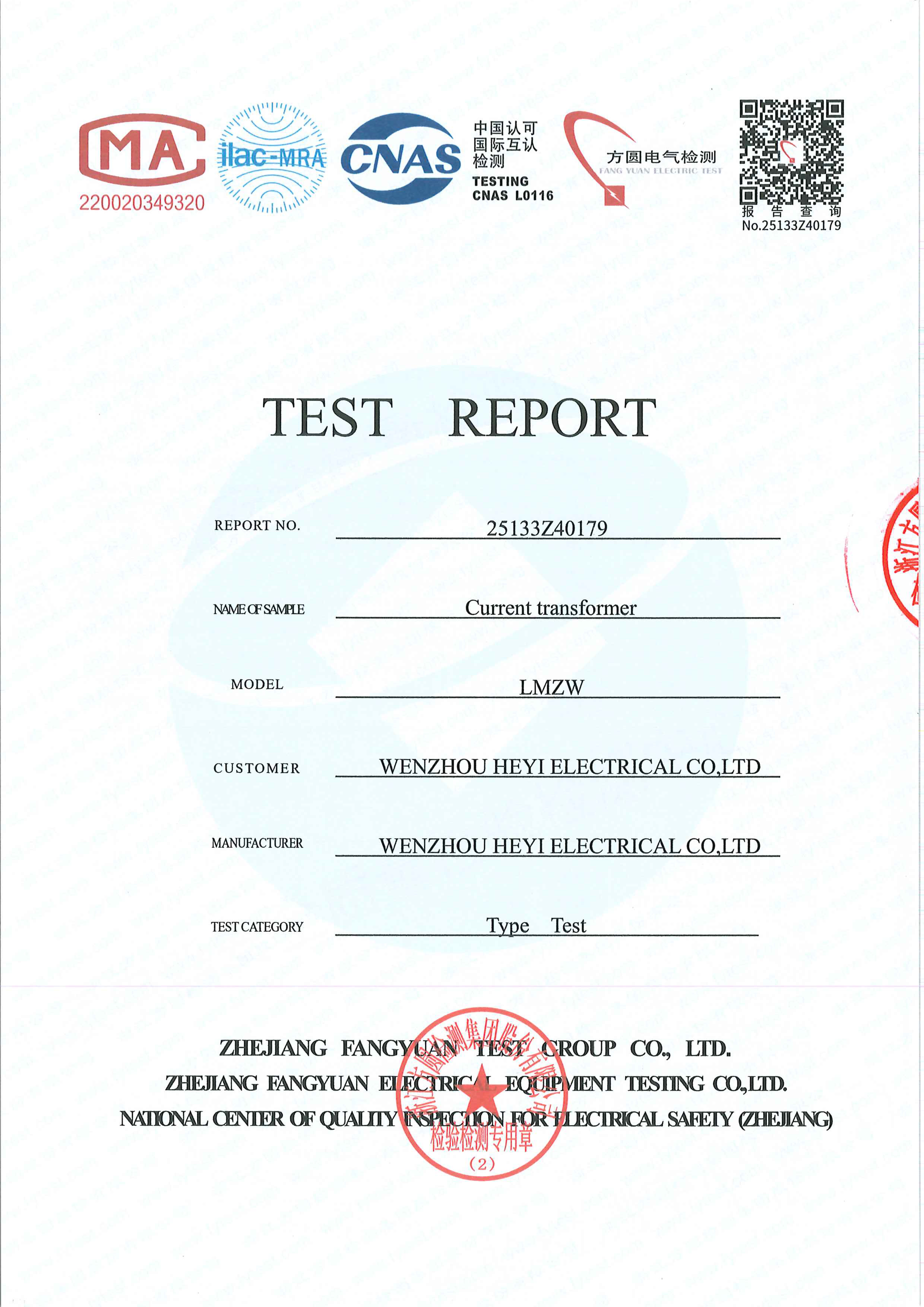
| IEC 61869 type test | Was the design type-validated to the standard? | 25133Z40179 — LMZW, IEC 61869-1 and IEC 61869-2 | Market access, RoHS, sister models |
| ISO 9001 certificate | Is the production system certified? | 20224Q21295R0S — production of low-voltage current transformers | Product compliance |
| IP code test report | Does the enclosure meet the stated IP rating? | Qst-23N020111-1SR — OCT, IEC 60529 | Electrical safety, accuracy |

EU market: CE is a set of files, not a single certificate
European buyers routinely ask for 'the CE certificate'. For a current transformer there is normally no such single document. There is a Low Voltage Directive file, an EMC file where the product falls within that directive, and a RoHS file. Each has its own number, its own issuing body and its own scope.
CE-LVD evidence
The LVD documents in the HEYI file show how much the wrapper can vary while the function stays the same. They are titled Attestation of Conformity, Verification of Conformity, Declaration of Conformity and Certificate of Conformity, and they come from TÜV SÜD Product Service GmbH, UDEM International Certification, Beide (Shenzhen) Product Service Limited and Shenzhen Easy Test Electronic Products Co., Ltd.
Two consecutive TÜV SÜD numbers illustrate the scope rule precisely. N8A 114572 0001 Rev. 00 is issued for the MSQ current transformer; N8A 114572 0002 Rev. 00 is issued for the DP/HK busbar split-core current transformer. Both cite EN 61869-1 and EN 61869-2. A buyer who orders DP/HK on the strength of '0001' has cited a document that does not name the product.
Multi-model scope does exist and must be read, not assumed. M.2023.206.C83963 from UDEM names both the OCT outdoor split-core transformer and the LMZW outdoor resin-cast transformer, cites IEC 60044-1:2003 and IEC 61869-2:2012, and runs from 2023-04-11 to 2028-04-10. Two standard generations appear in one document because the products were assessed across a transition period. If your purchase specification names one edition, check which edition the report addressed.
The HYCA residual current sensor adds a further lesson. Its attestation M.2023.206.C90639 cites IEC 62752:2016/A1:2018 and IEC 62955:2018 — residual current device standards for EV charging — not the generic CT standards. That is correct for a 6 mA DC / 30 mA AC residual current sensor, and it is also the reason the document cannot be reused to justify a metering CT.
CE-EMC evidence
Electromagnetic compatibility is a separate assessment. For the DP/HK busbar split-core transformer the file records verification B-E2505D2378 from Beide (Shenzhen) Product Service Limited, issued 2025-06-09 and valid to 2028-06-08, against EN IEC 61000-6-3:2021 and EN IEC 61000-6-1:2019. Those are generic emission and immunity standards from the EN 61000-6 series, which tells you the document addresses disturbance behaviour rather than dielectric strength or accuracy.
The practical consequence: a supplier can hold a complete LVD file and no EMC evidence for the model you are buying, or the reverse. Both statements are true at once, and neither is a contradiction.
RoHS evidence
RoHS is a substance-restriction question answered by document review and laboratory testing against the IEC 62321 series under Directive 2011/65/EU as amended by (EU) 2015/863. The HEYI file contains three different formats: attestation LCSA03054058R for the HYCA sensor issued 2024-03-15 by Shenzhen LCS Compliance Testing Laboratory; test report LCSE03115005R for the KCT split-core series issued 2025-03-12 by Ningbo LCS Standard Technology Service; and SGS verification report SHAEC2123838801 dated 2021-12-20 covering the MSQ and DP/HK.
None of these three documents says anything about electrical safety, accuracy class or EMC. RoHS compliance is a materials statement, and treating it as a safety certificate is one of the most common reading errors in low-voltage component procurement.

UK market: UKCA is a separate file for a separate destination
Great Britain operates its own product-marking framework, and a UKCA document is not a relabelled CE document. For the KCT and KCT-L split-core / true-RMS current transformer series, the file records UKCA reference CLZJ23072649108. It sits alongside, not instead of, the EU evidence for the same family: CE-LVD declaration ET16118324-LVD issued 2016-11-10 against IEC 61869-2:2012, and RoHS test report LCSE03115005R issued 2025-03-12.
Reading a UKCA document follows the same discipline as reading a CE one, with the destination changed:
- Designated standard. UK files normally cite the BS EN edition of the same standard family. Confirm the edition rather than assuming it matches the EN version on your EU file.
- Approved body involvement. Where the applicable rules require an approved body, the body and its number should appear on the document. Where they do not, the basis of the claim should still be stated.
- Model list. The KCT and KCT-L are separate designations. A file that names the series should be read to see whether it names the variant you are ordering.
- Market named. A document issued for Great Britain does not create EU market access, and an EU attestation does not answer a UK buyer who has asked for UKCA evidence.
- Validity. Record the date on the document itself. UK requirements have been revised more than once, and an undated claim is not verifiable.
Both files existing is normal and healthy. What is not acceptable is a supplier who answers a UK request by sending an EU attestation and describing it as equivalent.
China: what metrological verification actually covers
The Chinese metrology layer is frequently misread by overseas buyers, and the HEYI file shows exactly why. Certificate D20250900173, issued 2025-09-15 by the Yueqing Institute of Quality and Technical Supervision Inspection and valid to 2027-09-14, is recorded against JJG 313-2010. Its scope sentence reads: standard current transformer with current booster, model HLS21-2S, ratio 5A/5A to 2000A/5A.
That is a verification of a reference standard used for ratio and accuracy work in the factory. It supports the traceability of the measurement bench. It does not certify the CTs that will be shipped to you, and it is not a substitute for a type test or a CE file. A buyer who reads the headline 'metrological verification certificate' as product approval has skipped the scope sentence — the same error as reading a CE-LVD number as an EMC document.
The equipment calibrations in the same file reinforce the point. D20250900172 and D20250900171 cover the HL04 current load box under JJF 1264-2010, and D20250900170 covers the BF2670AM withstand voltage tester under JJG 795-2016, issued 2025-09-08. All three are instrument calibrations.
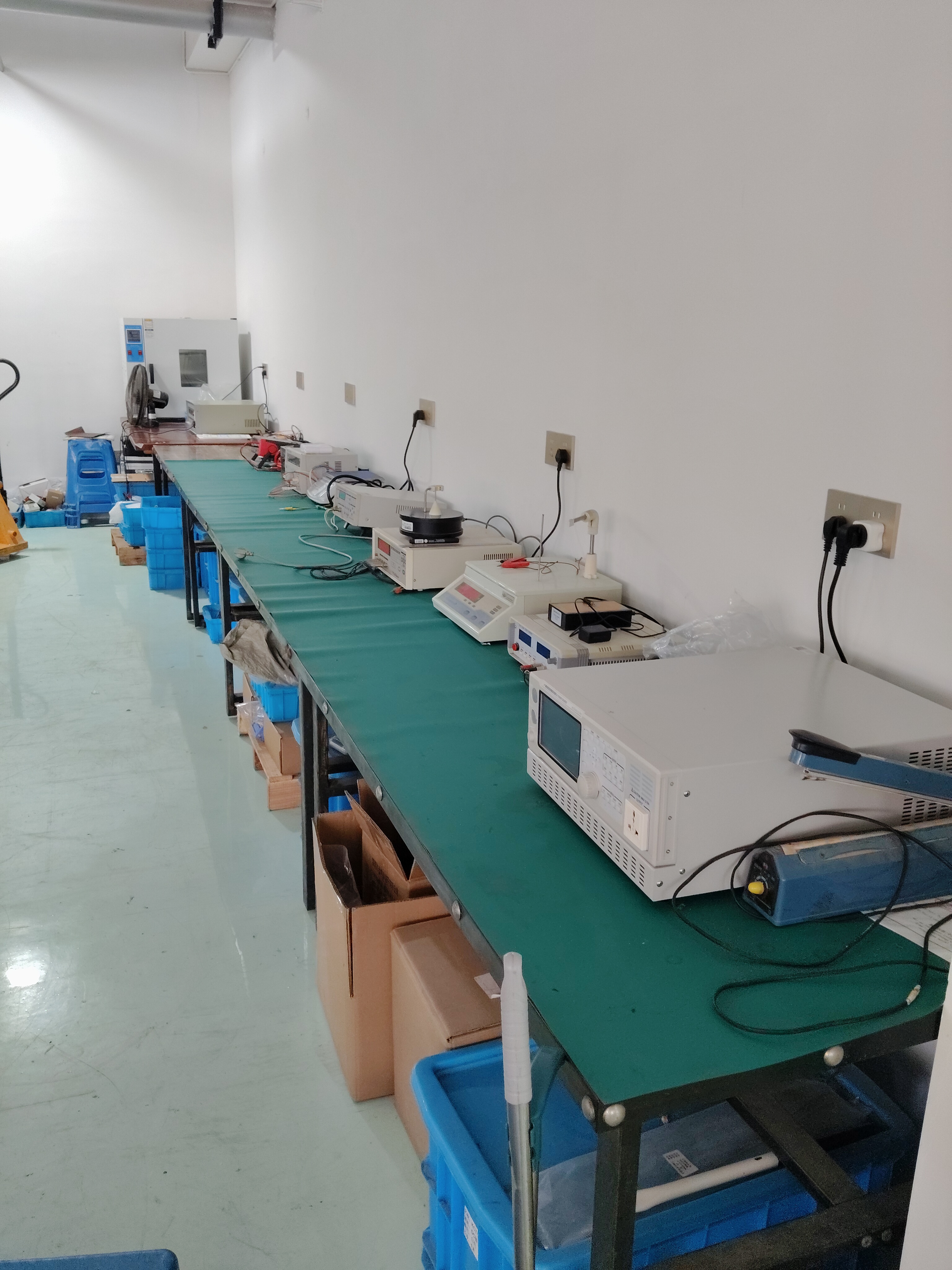
Used correctly, these documents are genuinely useful. The HEYI capability file states 100% routine testing covering accuracy, insulation resistance, withstand voltage and appearance inspection before shipment. Calibrated reference standards and test instruments are what make those routine results meaningful. Ask for them as evidence of the test bench, not as evidence of the product.

Global type tests: design validation, not market access
A type test answers one question: has this design been validated against a named standard on a representative sample? It does not answer whether the product may be sold in a market, and it does not transfer between models.
Two reports in the HEYI file show the difference in scope wording. Report 25133Z40179, issued 2025-04-17 by Zhejiang Fangyuan Test Group Co., Ltd., is scoped to 'Model LMZW Current Transformer' and cites IEC 61869-1 and IEC 61869-2. Report 25T0221-S, issued 2025-05-01 by Suzhou Electrical Apparatus Science Research Institute Co., Ltd., is scoped more broadly to 'Current Transformer', with the standard recorded as the IEC/EN 61869 series — the specific part should be confirmed on the document itself rather than inferred.
The LMZW report is the easier one to file: the model is named, the standard parts are named. The RECT report requires one extra question from the buyer, because the product is described as an IEEE C57.13 revenue-grade design while the recorded report follows the IEC/EN 61869 series. If your specification cites IEEE C57.13, confirm which standard the report addresses before accepting it. This is not a defect in the product; it is a question about whether the evidence matches your specification.
Note also what a type test is not. It is not a routine test: routine testing happens on every unit. It is not market access: an IEC report does not create CE or UKCA status. And it is not transferable: a report for the LMZW says nothing about the CP, the DP/HK or the HYCA.
Step-by-step: a seven-check reading routine
Apply the same seven checks to every document, in this order. It takes a few minutes per file and prevents most sourcing errors.
- Name the exact model. Match the model designation on the document to the model on the purchase order. N8A 114572 0001 and 0002 differ by one digit and by one product.
- Read the document title. Attestation, verification, declaration, certificate, test report and calibration record are different instruments with different weight.
- Read the directive or scheme. 2014/35/EU, 2014/30/EU, 2011/65/EU with (EU) 2015/863, UKCA, JJG 313-2010 and ISO 9001:2015 belong to different layers. Confirm the document addresses the layer your buyer is asking about.
- Read the standard and its edition. IEC 61869-2:2012, EN 61869-2:2012, IEC 60044-1:2003 and EN IEC 61000-6-3:2021 are not interchangeable, even when the technical content overlaps.
- Read the scope sentence. 'Model LMZW Current Transformer', 'Current Transformer', 'Fluxgate Residual current sensor' and 'Type B Residual Current Monitoring Unit' point to different products and different obligations.
- Read issue and expiry dates. A recorded expiry of 2099-12-31 usually means no expiry was assigned — not that the assessment is recent. M.2023.206.C90639 carries a real five-year window ending 2028-09-20; ET16118324-LVD dates from 2016. Compare the assessment date to your project timeline.
- Match to destination and contract. EU, Great Britain, China and global type-test claims are separate answers. File each document under model plus market, and record which question remains open.
The register, read by model
Applied to the HEYI file, the routine produces a short register. It shows coverage that is document-by-document rather than product-family-wide.
| Model | Documents recorded | Market addressed |
|---|---|---|
| MSQ | CE-LVD N8A 114572 0001 Rev. 00; CE-LVD B-S2410C4272; RoHS SHAEC2123838801 | EU |
| DP/HK busbar split-core | CE-LVD N8A 114572 0002 Rev. 00; CE-EMC B-E2505D2378; RoHS SHAEC2123838801 | EU |
| OCT outdoor split-core | CE-LVD M.2023.206.C83963; IP65 report Qst-23N020111-1SR | EU / global |
| LMZW outdoor resin-cast | CE-LVD M.2023.206.C83963; type test 25133Z40179 | EU / global |
| HYCA residual current sensor | CE-LVD M.2023.206.C90639; RoHS LCSA03054058R | EU |
| CP compact DIN-rail CT | CE-LVD B-S210737499 | EU |
| KCT split-core | CE-LVD ET16118324-LVD; RoHS LCSE03115005R | EU |
| KCT / KCT-L | UKCA CLZJ23072649108 | Great Britain |
| RECT revenue-grade | Type test 25T0221-S | Global |
Two observations follow. First, EMC evidence is recorded for one model in this set; the LVD attestations do not substitute for it. Second, RoHS evidence appears for the HYCA, KCT, MSQ and DP/HK, and should be requested explicitly for any other model in the order. Neither observation is a criticism of the supplier — it is how real files look when documents are issued project by project.

Use cases: the same routine in three real buying situations
EU panel builder, commercial sub-metering. The tender requires CE-LVD, CE-EMC and RoHS for the exact model. A DP/HK busbar split-core unit answers all three from this file: LVD under N8A 114572 0002 Rev. 00, EMC under B-E2505D2378, RoHS under SGS report SHAEC2123838801. Substituting the MSQ documents fails on model identity even though the numbers sit next to each other in the folder.
UK distributor stocking split-core CTs. The British buyer asks for UKCA. The KCT and KCT-L reply with CLZJ23072649108 for Great Britain plus RoHS test report LCSE03115005R; the EU declaration ET16118324-LVD stays in the EU file where it belongs. Two files, two destinations, no substitution.
EV charger manufacturer. The design needs a 6 mA DC residual current sensor. The HYCA evidence is LVD attestation M.2023.206.C90639 against IEC 62752:2016/A1:2018 and IEC 62955:2018, plus RoHS attestation LCSA03054058R. A separate TÜV Rheinland certificate of conformity, AK 50656386 0001, is scoped to a Type B residual current monitoring unit under EN 62752:2016+A1, IEC 62752:2016+A1 and IEC 62955:2018. Read all three before deciding which one your charger certification actually leans on.
Utility billing project. The specification cites a revenue-grade class. The RECT is described as an IEEE C57.13 revenue-grade design and its file contains type test 25T0221-S recorded against the IEC/EN 61869 series. Confirm the standard basis before the report is entered into the technical submittal.
Where buyers most often get it wrong
- Model inheritance. Using a certificate issued for one model to justify a sister model. Sequential numbers do not imply shared scope.
- Treating CE as one document. Asking for 'the CE certificate' invites whichever paper is closest to hand. Ask for the directive.
- Reading a 2099 expiry as recency. It usually means no expiry date was assigned. The assessment date is the useful field.
- Treating RoHS as electrical safety. It is a materials declaration supported by IEC 62321 testing.
- Treating a metrological verification as product approval. It verifies a reference standard or instrument, not the shipped unit.
- Treating an ISO 9001 certificate as product compliance. Certificate 20224Q21295R0S covers production of low-voltage current transformers from 2024-11-21 to 2027-11-20; it is a system certificate.
- Assuming CE covers Great Britain. UKCA evidence for the KCT and KCT-L exists precisely because it is a separate question.
FAQ
What should 'current transformer manufacturers with CE' mean in practice?
It should mean the manufacturer can produce a CE-related document that names your model, cites the applicable directive and standard, and states the issuing body and dates. HEYI's file contains CE-LVD attestations and verifications covering the MSQ, DP/HK, OCT, LMZW, HYCA and CP, CE-EMC verification B-E2505D2378 for the DP/HK, and RoHS evidence for the HYCA, KCT, MSQ and DP/HK. Coverage is document by document, so the correct question is not 'are you CE certified' but 'which document covers this model under this directive'.
Which CE directive applies to a current transformer — LVD, EMC or RoHS?
They answer different questions and are usually requested together. The Low Voltage Directive 2014/35/EU produces the electrical safety evidence, such as M.2023.206.C90639 for the HYCA or N8A 114572 0002 Rev. 00 for the DP/HK. The EMC Directive 2014/30/EU produces electromagnetic compatibility evidence, such as B-E2505D2378 against EN IEC 61000-6-3:2021 and EN IEC 61000-6-1:2019. RoHS under 2011/65/EU as amended by (EU) 2015/863 produces substance-restriction evidence tested to the IEC 62321 series. One directive's document never satisfies another's requirement.
Does a UKCA certificate for the KCT series replace the CE documents?
No. UKCA reference CLZJ23072649108 addresses the Great Britain scheme for the KCT and KCT-L series. The EU evidence for the KCT family is separate: declaration ET16118324-LVD issued 2016-11-10 against IEC 61869-2:2012, plus RoHS test report LCSE03115005R issued 2025-03-12. If you ship to both destinations, keep both files and cite each in the correct market.
What is the difference between a type test report and a CE document?
A type test validates a design against a performance standard; a CE document supports market access under an EU directive. Report 25133Z40179 for the LMZW cites IEC 61869-1 and IEC 61869-2 and is scoped to that model. Report 25T0221-S for the RECT is scoped to 'Current Transformer' with the standard recorded as the IEC/EN 61869 series. Neither report creates CE or UKCA status, and neither covers a different model.
Can a Chinese metrological verification certificate be used for an EU submittal?
Not as product conformity evidence. Certificate D20250900173 verifies a standard current transformer with current booster, model HLS21-2S with ratios from 5A/5A to 2000A/5A, under JJG 313-2010, valid from 2025-09-15 to 2027-09-14. It supports the traceability of the factory's measurement bench. For an EU submittal you need the directive-specific documents for the model being supplied.
Does a RoHS report prove the current transformer is safe to install?
No. RoHS documents such as LCSA03054058R for the HYCA or LCSE03115005R for the KCT report restricted-substance testing to the IEC 62321 series. They say nothing about dielectric strength, accuracy, thermal behaviour or EMC. Safety evidence comes from the LVD file and the applicable product standard.
What should I send with an RFQ so the right certificate comes back first time?
Send four items: the exact model and variant, the destination market, the directive or scheme your buyer requires, and the standard edition cited in your specification. Add the required document language if your technical file is reviewed in a specific language. With those four, a supplier can return the correct number instead of the nearest one. The HEYI documentation set and full catalogue can be requested at bethy@heyiele.com, and the current catalogue is available for download at the HEYI brochure. Samples for bench verification can be arranged alongside the document pack.
Conclusion
Compliance for a current transformer is not a status a company holds; it is a set of claims, each narrowed by model, scheme, market and date. The HEYI file demonstrates the pattern clearly: LVD attestations for the MSQ, DP/HK, OCT, LMZW, HYCA and CP; EMC verification B-E2505D2378 for the DP/HK; RoHS evidence across HYCA, KCT, MSQ and DP/HK; UKCA CLZJ23072649108 for KCT and KCT-L; metrological verification D20250900173 for the HLS21-2S reference standard; and type tests 25133Z40179 for the LMZW and 25T0221-S for the RECT.
Read those seven checks in order — model, title, scheme, standard, scope, dates, destination — and the sourcing decision becomes a filing exercise rather than a judgement call. Buyers who skip the scope sentence are not buying compliant parts; they are buying a document number and hoping it applies.
For model-specific documentation, certificate scope confirmation or a sample for bench testing, contact HEYI ELECTRICAL at heyiele.com or write to bethy@heyiele.com.
Have Questions or Need More Details?
Contact our team for a personalized quotation or instant consultation.
Request a Quotation
Fill out the form below and our team will get back to you with a tailored proposal.
WhatsApp Direct Chat
Prefer to chat in real-time? Message us on WhatsApp for instant assistance & quick answers.
- Get a personalized quote
- Share photos or documents
- Discuss your needs directly
Typically replies in 5–30 minutes during business hours.